

AI is not producing one simple labor-market outcome. It is slowing some hiring, redirecting investment, creating new technical roles, and increasing pressure on organizations to become more deliberate about workforce design, skills, and delivery models.
AI Is Redesigning Work
If you’ve been following headlines about artificial intelligence, you’ve probably seen two extremes: AI is either going to eliminate jobs at scale, or it’s going to unlock unlimited productivity. Neither of those narratives is particularly useful if you’re actually responsible for delivering work.
After reviewing current data, industry reporting, and recent thought leadership—including insights from AI, Lean, Agile & Six Sigma in Action, Agile AI-Augmented HR Leadership, and The AI Strategy Blueprint—a more grounded reality comes into focus: AI isn’t replacing work, it’s restructuring how work gets done. And that shift is already showing up in hiring patterns, team structures, and delivery expectations.

What This Means for Project Managers
The forces reshaping the labor market are not abstract to project managers — they show up directly in how projects are scoped, staffed, and delivered.
You may already be seeing it: a team member's role has quietly shifted because their department is piloting an AI tool, and no one updated the Responsible, Accountable, Consulted, and Informed Matrix, also known as the RACI. A stakeholder introduces a new automation mid-project and expects it to accelerate delivery, but the team hasn't been trained on it yet. A subject matter expert who carried years of institutional knowledge retired or moved on, and what they knew didn't make it into any documentation.
These aren't edge cases anymore. They are increasingly common conditions that project managers are expected to navigate without a clear playbook.
The challenge is that most of the conversation about AI and the future of work is framed at the organizational level — strategy, investment, headcount decisions. Project managers operate one level below that, where strategy meets execution. That is exactly where the friction shows up: in unclear ownership, shifting dependencies, resource plans that don't reflect how work is actually being done, and teams being asked to deliver more with tools they're still learning.
Understanding the broader trends covered in this article isn't just useful context. It helps project managers anticipate where projects are likely to break down, ask better questions during planning, and make a stronger case for what their teams actually need to succeed.
The Hiring Slowdown
At first glance, hiring trends might look concerning. Global hiring is still sitting about 20% below pre-pandemic levels (LinkedIn, 2026). That sounds like contraction.
So What’s Actually Happening?
Organizations aren’t broadly cutting jobs. They’re hesitating. They’re reallocating. They’re trying to figure out what their workforce should look like in an AI-enabled environment.
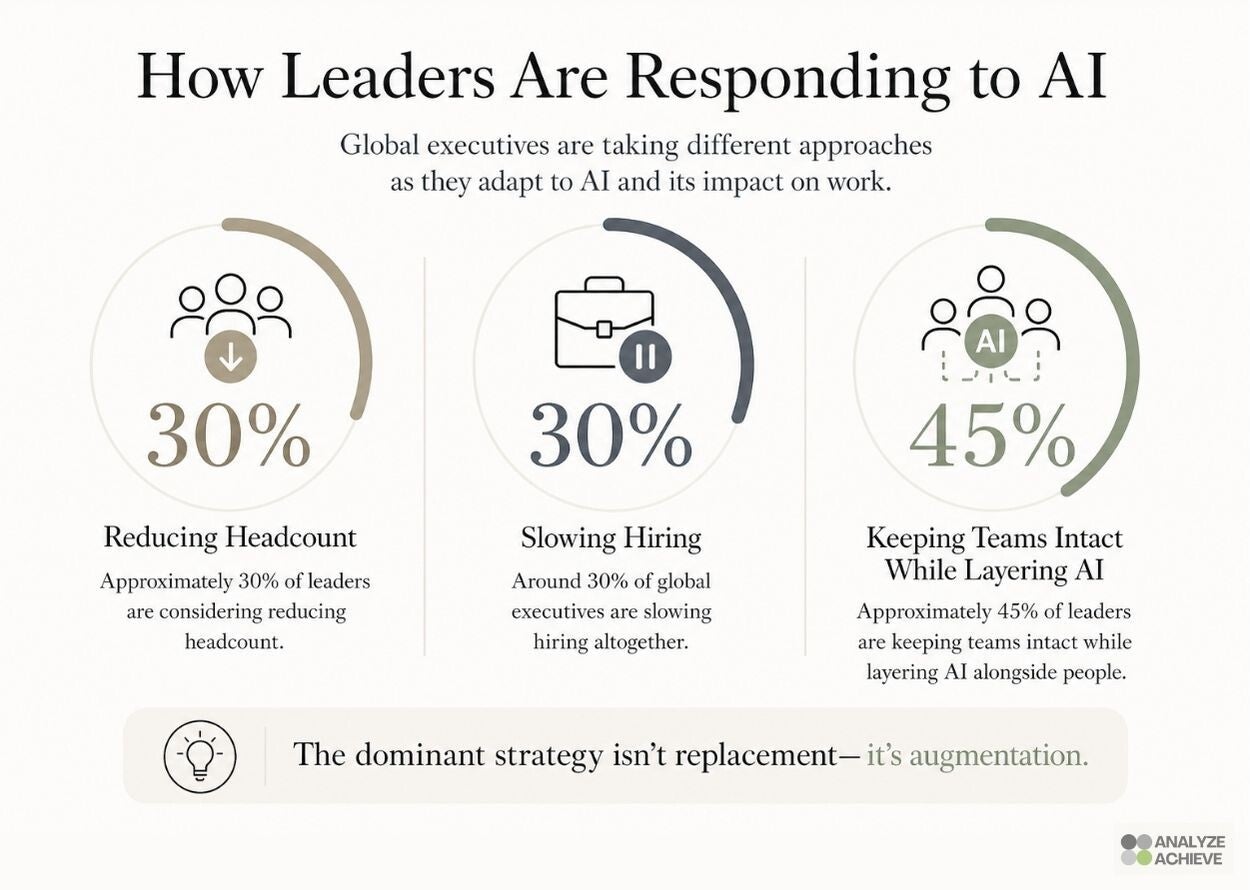
That uncertainty shows up clearly in leadership behavior:
- Approximately 30% of leaders are considering reducing headcount
- Around 30% of global executives are slowing hiring altogether
- And approximately 45% of leaders are keeping teams intact while layering AI alongside people (Programs.com, 2026).
The approach to an AI workplace isn’t a unified strategy. It’s experimentation that varies depending on the needs surfacing regularly as organizations try to navigate change.
From Jobs to Workflows
One of the most consistent themes across all sources is that organizations are asking the wrong question. They’re asking: “Which jobs will AI replace?” When they should be asking: “Which parts of this work can be automated, augmented, or redesigned?” That distinction matters because most jobs aren’t disappearing; they’re being broken apart and reassembled.
Repetitive tasks are being automated while decision-support tasks are being augmented. And entirely new responsibilities—like managing AI tools—are being introduced. This change is what’s often referred to as workflow transformation: redesigning how work is completed, not just who does it.
New Roles Are Emerging
AI isn’t just changing existing jobs; it’s creating new ones:
- Prompt engineers
- AI trainers
- AI ethicists
- AI product managers
- Human-AI interaction designers
These roles are not purely technical. They operate at the intersection of business, systems thinking, and human behavior. This approach aligns with Agile AI-Augmented HR Leadership, which emphasizes that organizations are redefining how people and technology collaborate, rather than simply adopting new tools. As a result, the most valuable employees will be those who can connect systems, workflows, and outcomes. However, valuable employees cannot operate effectively within an ineffective organization.
AI Workforce Strategy
Companies are pouring massive capital into AI infrastructure, and it is a part of how organizations think about growth, capability, and competitive advantage. However, AI doesn't inherently create efficiency. Instead, it amplifies whatever system it's introduced into. If a process is inefficient, AI will scale that inefficiency faster. That's why combining AI with Agile (adaptability), Lean (waste reduction), and Six Sigma (consistency and quality) yields real gains (Qayoom, 2025). When AI is viewed as a core operational capability, not just a cost-cutting tool, productivity gains become real.
Leadership
Most executives believe AI is already saving significant time; Yet, many employees don't see that benefit firsthand. This gap in experience is reinforced by unequal access to AI tools and training. Making this issue an implementation problem rather than a technology problem. Often, leadership assumes that simply adopting AI will suffice, but this leaves teams struggling to integrate tools into real workflows, and expected productivity gains never fully materialize. Therefore, it's imperative for leadership to engage employees in the implementation process and to provide guidance on how and when to use AI as team structures change and role boundaries blur.
Read more about the risks and impact AI can have on worker morale in our article, Agile Meets AI
Adaptability
Project managers are increasingly expected to deal with changing team structures, unclear role boundaries, the introduction of new tools midstream, and skill gaps that slow down delivery. The organizations that will adapt best aren’t just adopting AI, they’re moving toward adaptive resource orchestration (Mohiman et al., 2025). This framework isn’t a future-state idea; instead, it’s a shift in how an organization operates.
At its core, that means three things:
Continuously rebalancing work across people, AI, and automation
Not as a one-time transformation, but as an ongoing decision process.
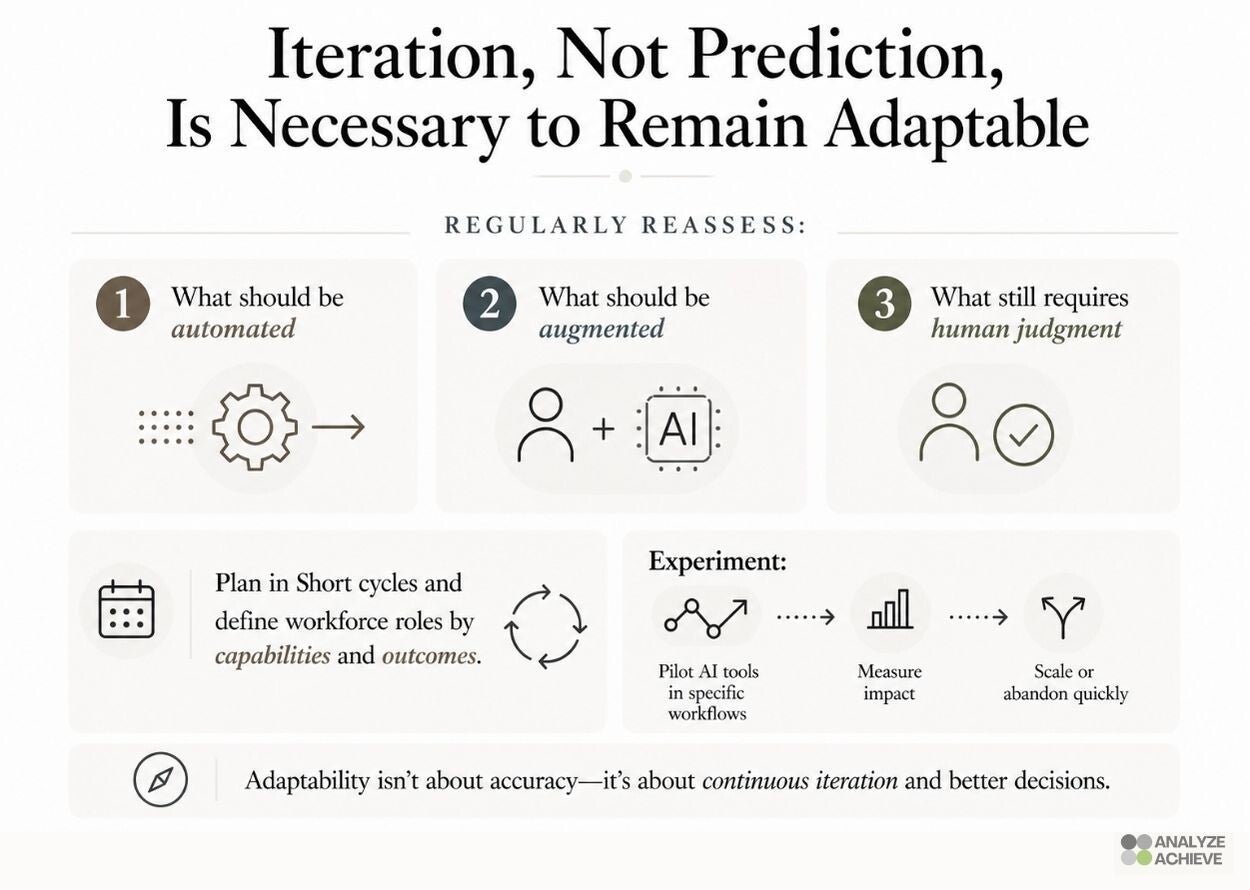
Treating workforce planning as iterative
Less annual headcount planning, more sprint-based capability planning.
Designing workflows that can evolve
Processes aren’t fixed—they’re built to flex as tools, roles, and constraints change (World Economic Forum, 2026b).

Hiring has become uncertain as roles are being redefined faster than they can be filled, tasks are being redistributed between humans and machines, and organizations aren't keeping pace with education and reskilling needs. That is why iteration, not prediction, is necessary to remain adaptable as the workforce is re-designed. Keep feedback loops open to measure actual improvements and complications arising from AI and AI automation implementation. Reach out across organizational silos to improve cross-functional workflow structures. The emphasis is on an organization's ability to adapt quickly while simultaneously managing worker knowledge.
Capability Risk Now Includes the Loss of Human Expertise
Most organizations think of capability risk in terms of skills gaps—what they don’t have. Yet, the more immediate risk is what they’re actively losing. As AI and automation accelerate, organizations are offloading tasks that experienced employees once performed. On the surface, this looks like efficiency. But beneath the surface, something more subtle is happening: tacit knowledge is disappearing.
Tacit knowledge is the unwritten, experience-based know-how that doesn’t live in SOPs, playbooks, or systems. It’s how a project manager senses risk before it appears on a dashboard. It’s how an instructional designer adjusts a solution mid-build in response to stakeholder behavior. It’s how operations teams work around constraints that no system has fully mapped.
When you automate without preserving that layer of expertise, you’re not just improving efficiency—you’re eroding capability.
Why This Matters More Than It Seems
AI systems can replicate patterns, optimize workflows, and even make decisions. But they depend on the quality of the inputs and the context they’re given.
When tacit knowledge disappears:
- Decision quality degrades over time
- Edge cases become failure points
- Teams lose the ability to adapt when systems break or conditions change
- Organizations become over-reliant on tools they don’t fully understand
The loss of expert knowledge creates a fragile operating model. One that performs well under normal conditions but struggles under pressure.
Where Organizations Get It Wrong
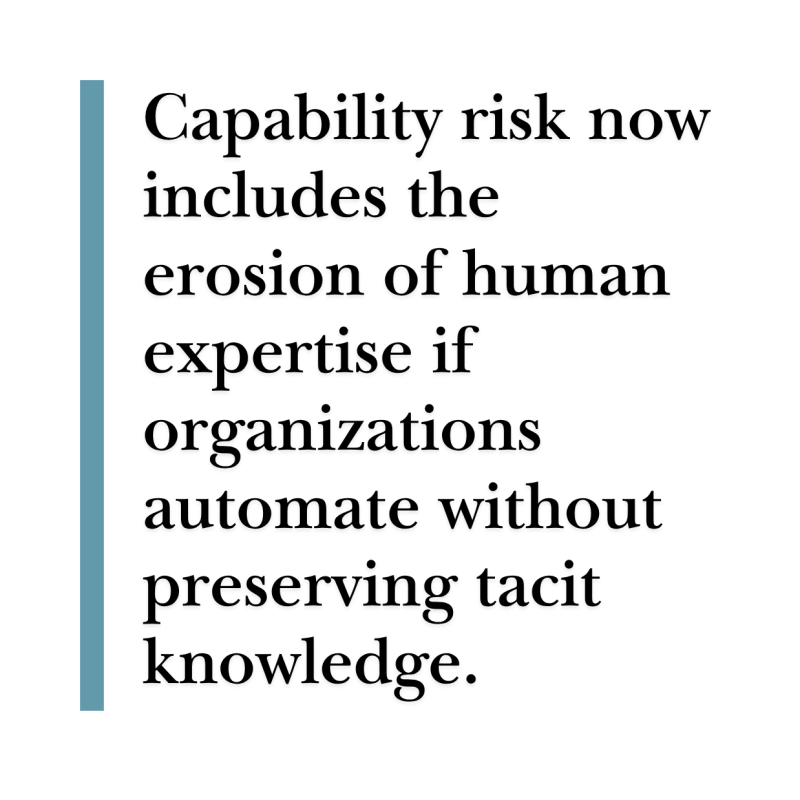
The mistake isn’t automation itself. It’s how automation is implemented. Capability risk now includes the erosion of human expertise if organizations automate without preserving tacit knowledge.
Most organizations:
- Automate tasks without documenting decision logic
- Replace human judgment without capturing how that judgment was formed
- Assume systems can “learn” everything that experienced employees know
- Treat knowledge transfer as optional instead of operationally critical
In reality, tacit knowledge doesn’t transfer passively. If you don’t design for it, you lose it.
What Preserving Tacit Knowledge Actually Looks Like
If you’re serious about long-term capability, preservation needs to be built into how work is redesigned.
That means:
- Capture decision-making, not just process steps
Document why decisions are made, not just what gets done, because that is where most of the value lies. - Pair automation with structured knowledge extraction
Before automating a workflow, identify:
-Key judgment points
-Exceptions and edge cases
-Workarounds that experienced employees rely on - Build feedback loops between people and systems
AI should not be a one-way replacement. Create mechanisms where employees:
-Review outputs
-Override when necessary
-Feed context back into the system - Treat expertise as an asset to be cultivated, not assumed
Make tacit knowledge visible through:
-After action reviews
-Decision logs
-Scenario-based documentation
The bottom line is that if you’re not actively preserving tacit knowledge, you’re becoming less capable over time.

Action Items
Focus on Workflows, Not Just Roles
The nature of work is undergoing a fundamental transformation, with changes occurring at the task level. To effectively harness the power of AI, businesses must first focus on redesigning workflows. By streamlining workflows, organizations can then redefine roles to support these new processes. This approach ensures that AI is not just an add-on but an integral component of how work gets done, leading to more efficient and effective operations.
Invest in Training—Not Just Tools
Having access to advanced AI tools is only part of the equation. Without the necessary training, these tools can become bottlenecks rather than enablers. Investing in comprehensive training programs is crucial for converting access to AI into tangible impact. By equipping employees with the skills and knowledge they need to use AI effectively, organizations can unlock the full potential of these technologies and drive meaningful change.
Align AI Efforts with Actual Business Needs
For AI initiatives to be truly strategic, they must be aligned with the organization’s core business needs. AI efforts should have a direct connection to improving cost, speed, quality, or revenue. If AI projects do not contribute to these key areas, they risk becoming mere experiments rather than strategic imperatives. By focusing on alignment, organizations can ensure that their AI initiatives are both purposeful and impactful.
Measure Outcomes, Not Activity
Measuring success requires a shift in focus from activity to outcomes. Usage metrics alone do not provide a complete picture of AI’s impact. Instead, organizations should assess metrics such as cycle time, error rates, and overall business impact. By prioritizing these outcome-based metrics, businesses can better understand the true value of their AI initiatives and make informed decisions about future investments.
Where There Is Still Uncertainty
Varying Pace of Adoption
The adoption of Artificial Intelligence (AI) across industries is not uniform. Some sectors are poised to embrace AI quickly, driven by a natural alignment with technological innovation and fewer regulatory barriers. For instance, the tech industry, known for its agility and forward-thinking mindset, is likely to be at the forefront of AI adoption. These sectors often have a high tolerance for risk and the capability to integrate AI seamlessly into their operations, leveraging it to enhance productivity and drive innovation.
Conversely, industries such as healthcare and finance may experience slower adoption rates. These sectors are heavily regulated, and technological changes must comply with stringent legal and ethical standards. Additionally, they often deal with legacy systems deeply embedded in their infrastructure, making the integration of new technologies challenging. The cautious nature of these industries stems from a need to minimize risk, ensure reliability, and maintain trust with stakeholders.
Variability in Productivity Gains
The impact of AI on productivity is largely contingent upon how it is implemented within an organization. The same AI tool can lead to significant efficiency improvements in one organization while proving to be a source of confusion and inefficiency in another. The key differentiator is execution—how well the tool is integrated into existing processes and how effectively the workforce is equipped to harness its capabilities.
Organizations that successfully integrate AI often see streamlined operations, reduced errors, and enhanced decision-making capabilities. However, poor implementation can lead to increased complexity, employee resistance, and failure to meet desired outcomes. Thus, strategic planning, thorough training, and clear communication are essential to maximize the benefits of AI.
The Crucial Role of Reskilling
Without intentional upskilling, the introduction of AI could lead to widespread job loss, as automation might replace tasks traditionally performed by humans. However, when employees are empowered with new skills, they can take on more complex roles that require creativity, critical thinking, and emotional intelligence—areas where humans excel over machines.
Key Takeaways
AI is not eliminating work — it is restructuring it. Hiring is slower and more deliberate, roles are being redefined faster than they can be filled, and organizations are still figuring out what an AI-enabled workforce actually looks like in practice. For project managers, that uncertainty is already showing up in the work: shifting team structures, blurred role boundaries, mid-project tool introductions, and skill gaps that slow delivery.
The organizations adapting best are not simply adopting AI — they are redesigning how work flows among people, systems, and automation. That requires treating workforce planning as iterative rather than annual, measuring outcomes rather than tool usage, and aligning AI efforts directly with business results such as cost, speed, and quality.
One risk that rarely gets enough attention is the loss of tacit knowledge. As tasks are automated, the experience-based judgment that experienced employees carry — the kind that doesn't live in any SOP — quietly disappears. Preserving it requires intentional design: documenting decision logic, creating feedback loops between people and systems, and treating expertise as an asset worth protecting.
The bottom line for project managers: the future of work is not something happening to your organization from the outside. It is a design problem, and project managers are well-positioned to help solve it.
Additional Articles
Why 'Being Agile' Matters More Than Ever
The relationship between Agile and project management (PM) has fundamentally changed over the years. What were once seen as competing approaches are now integrated into a single capability: delivering value in complex, fast-changing environments. Market volatility, rapid technological change, and evolving workforce expectations have forced a shift in how work gets done. Organizations that rely solely on traditional PM struggle to adapt. Those who adopt Agile practices without changing how they think and operate fall into what many call “Agile theater.”
What Project Managers Need to Know About the Future of Work
If you’ve been following headlines about artificial intelligence, you’ve probably seen two extremes: AI is either going to eliminate jobs at scale, or it’s going to unlock unlimited productivity. Neither of those narratives is particularly useful if you’re actually responsible for delivering work.
The Role of Artificial Intelligence in Universal Design for Learning
Artificial Intelligence (AI) is increasingly integrated into educational and workplace learning environments. Within instructional design and human performance technology (HPT), AI tools offer scalable mechanisms for personalization, automation, analytics, and accessibility. When viewed through the lens of Universal Design for Learning (UDL), AI has significant potential to operationalize flexibility at scale. UDL emphasizes proactive design for learner variability (Meyer, Rose, & Gordon, 2014). AI technologies—particularly adaptive learning systems, generative AI tools, learning analytics platforms, and intelligent tutoring systems—can help designers implement UDL principles more dynamically than static course design alone.
Universal Design for Learning in Instructional Design and Human Performance
Universal Design for Learning (UDL) is an educational framework grounded in cognitive neuroscience and inclusive design principles that aims to improve learning for all individuals by proactively reducing barriers to learning. Developed by the Center for Applied Special Technology (CAST), UDL extends the architectural concept of universal design—originally articulated by Mace (1985)—into educational contexts. Rather than retrofitting accommodations after barriers are encountered, UDL calls for designing learning environments that are flexible and accessible from the outset (Meyer, Rose, & Gordon, 2014).
Needs Assessment for Instructional Design
A needs assessment is a systematic process for identifying gaps between the current state and the desired state in performance, knowledge, skills, attitudes, or conditions, and using that information to make informed decisions about whether and how to intervene. Roger Kaufman defines needs assessment as "a process for identifying needs and placing them in priority order on the basis of what it costs to meet the need versus what it costs to ignore it" (Dean & Ripley, 2016, p. 43).
Agile Meets AI
Agile is a mindset for approaching and executing projects. It uses multiple methods and frameworks depending on the project's goals and alignment with the Agile Manifesto. Four values align with the manifesto: individuals and interactions over processes and tools; working software over comprehensive documentation; customer collaboration over contract negotiation; and responding to change over following a plan (Project Management Institute, 2017). The highest priority is to deliver continuous value to the customer in short, regular intervals. These shortened work process cycles help mitigate risk, reduce waste, and enable quick responses to change, enabling continuous improvement.
References
Hanby, J., & Byron, J. (n.d.). The AI strategy blueprint: The definitive playbook for transforming your organization with AI.
LinkedIn. (2026). Labor market report: Building a future of work that works. https://economicgraph.linkedin.com/content/dam/me/economicgraph/en-us/PDF/linkedIn-labor-market-report-building-a-future-of-work-that-works-jan-2026.pdf
Mohiman, M.A., Salem, A.H., & Eldin, Y.N. (2025). Adaptive resource orchestration as a visionary competency: Strategic coordination for agility, innovation, and institutional transformation. Middle East Journal of Scientific Publishing 8(4). https://journals.mejsp.com/assets/uploads/journals-researches/1764008062_3417769503.pdf
Programs.com. (2026). AI headcount statistics. https://programs.com/resources/ai-headcount-statistics/?utm_source=chatgpt.com
Qayoom, A. (2025). AI, Lean, Agile & Six Sigma in action: The complete playbook for operational excellence and intelligent automation.
World Economic Forum. (2026a). AI has already added 1.3 million new jobs. https://www.weforum.org/stories/2026/01/ai-has-already-added-1-3-million-new-jobs-according-to-linkedin-data/
World Economic Forum. (2026b). Four ways AI will impact job markets. https://www.weforum.org/stories/2026/01/four-ways-ai-impact-job-markets/?utm_source=chatgpt.com
Add comment
Comments