

When aligned with instructional design principles and grounded in human performance technology systems thinking, AI becomes a powerful enabler of inclusive, effective, and adaptive learning environments.
Artificial Intelligence (AI) is increasingly integrated into educational and workplace learning environments. Within instructional design and human performance technology (HPT), AI tools offer scalable mechanisms for personalization, automation, analytics, and accessibility. When viewed through the lens of Universal Design for Learning (UDL), AI has significant potential to operationalize flexibility at scale. UDL emphasizes proactive design for learner variability (Meyer, Rose, & Gordon, 2014). AI technologies—particularly adaptive learning systems, generative AI tools, learning analytics platforms, and intelligent tutoring systems—can help designers implement UDL principles more dynamically than static course design alone.
What Is Universal Design for Learning?
Universal Design for Learning (UDL) is an educational framework grounded in cognitive neuroscience and inclusive design principles that aims to improve learning for all individuals by proactively reducing barriers to learning. UDL extends the architectural concept of universal design into educational contexts, rather than retrofitting accommodations after barriers are encountered, and calls for designing learning environments that are flexible and accessible from the outset (Mace, 1985; Meyer, Rose, & Gordon, 2014). For a more in-depth look into UDL, click here.
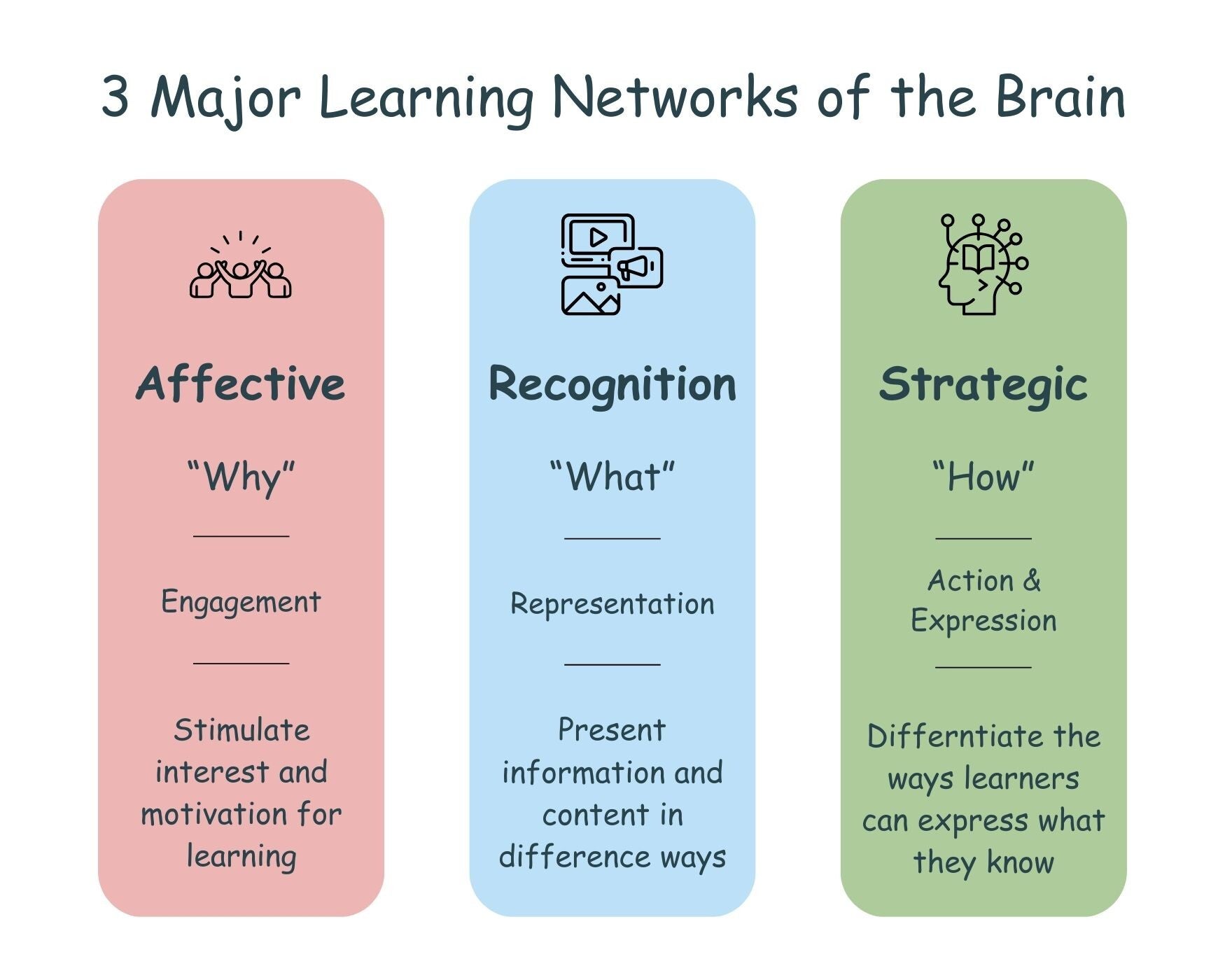
UDL is grounded in research from cognitive neuroscience with a focus on three major learning networks in the brain (Rose & Meyer, 2002; Meyer et al., 2014):
-
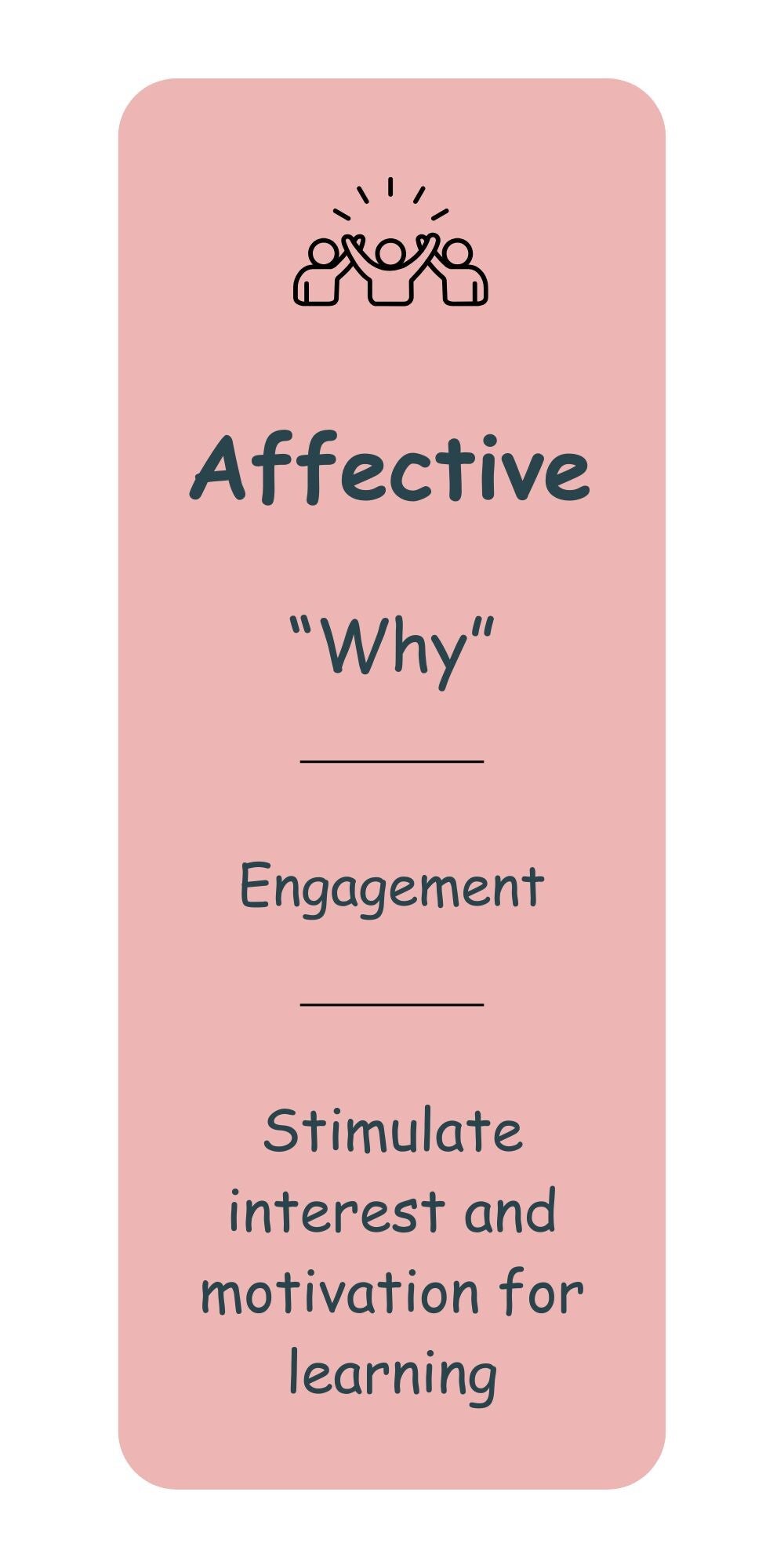
Affective networks – What motivates learners and sustains persistence?
-
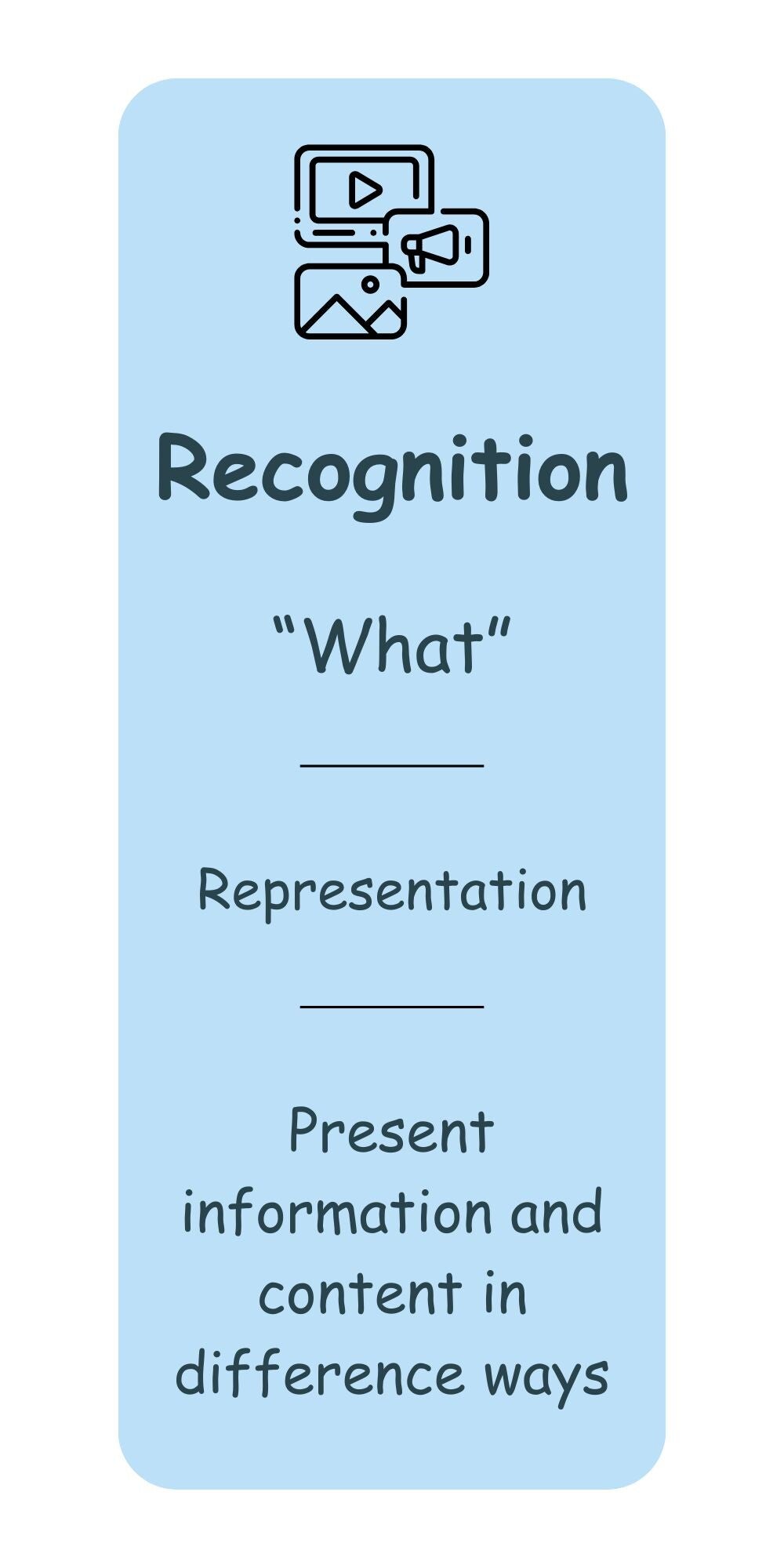
Recognition networks – How do learners perceive and comprehend information?
-
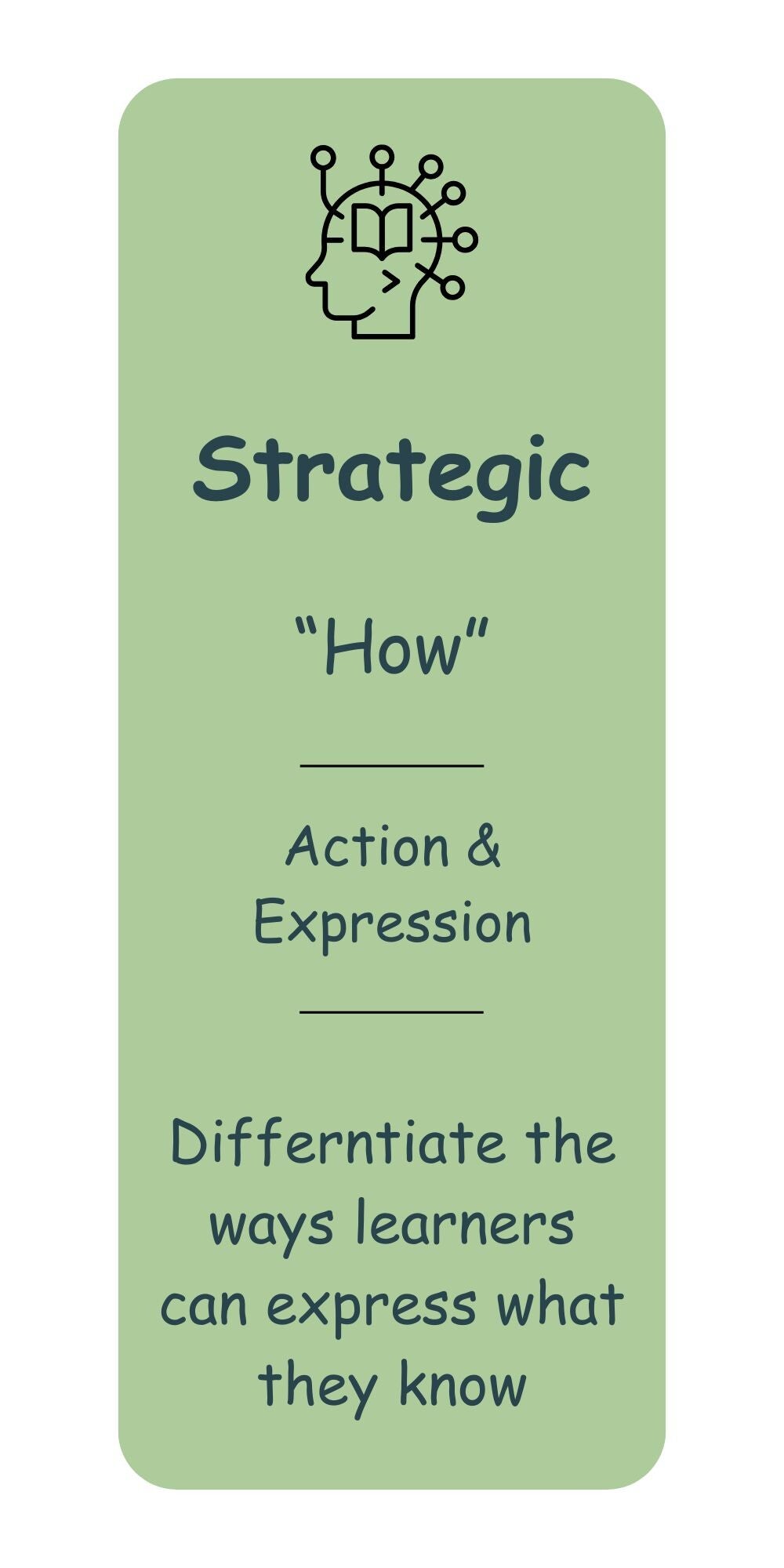
Strategic networks – How do learners demonstrate what they know?
For more details on UDL visit our article, Universal Design for Learning (UDL) in Instructional Design and Human Performance
AI Through the Lens of the Three UDL Networks
AI and the Affective Network (Multiple Means of Engagement)
The affective network addresses motivation, persistence, and interest.
AI supports engagement by:
-
Personalizing content pathways
-
Adjusting difficulty dynamically
-
Recommending relevant examples
-
Using predictive analytics to detect disengagement
-
Delivering gamified reinforcement systems
Adaptive learning platforms personalize challenge levels, supporting flow theory (Csikszentmihalyi, 1990) and motivational design principles (Keller, 2010).
Example:
If a learner struggles repeatedly, AI may adjust the difficulty, provide encouragement, or recommend review materials.
AI and the Recognition Network (Multiple Means of Representation)
The recognition network focuses on how learners perceive and comprehend information.
AI enhances representation by:
-
Automated captioning and transcription for video/audio content
-
Real-time translation for multilingual learners
-
Text simplification tools to adjust reading levels
-
Speech-to-text and text-to-speech systems
-
AI-generated visual summaries or infographics
These tools expand sensory and cognitive access pathways.
Example:
An AI-driven LMS might allow learners to toggle between summarized text, detailed explanations, audio narration, and visual concept maps.
From a cognitive load perspective (Sweller, 2011), AI can dynamically reduce extraneous load by adjusting content complexity or format.
AI and the Strategic Network (Multiple Means of Action & Expression)
The strategic network focuses on how learners plan, execute, and demonstrate learning.
AI supports action and expression through:
-
Adaptive assessment systems
-
Automated feedback generation
-
AI writing assistants
-
Speech recognition tools
-
Intelligent tutoring systems (ITS)
AI allows learners to demonstrate mastery in varied formats and receive immediate, formative feedback.
Example:
An AI tutor may analyze a learner’s response pattern and provide scaffolding prompts tailored to misconceptions.
This aligns with formative feedback principles in instructional design and performance improvement literature (Shute, 2008).
AI Applications in Instructional Design Using UDL
AI Applications in Instructional Design Using UDL
Adaptive systems modify content sequencing based on learner performance. These systems embody UDL by offering flexible pacing and differentiated representation.
From an HPT perspective, adaptive systems help align performance supports with individual needs (Gilbert, 1978).
Generative AI for Content Diversification
Generative AI can rapidly produce:
-
Alternate explanations
-
Practice questions
-
Case studies
-
Simulations
-
Role-play scripts
This enables instructional designers to efficiently implement multiple means of representation and engagement. Generative AI increases efficiency in creating varied learning materials; However, quality must be monitored.
Learning Analytics and Predictive Modeling
AI-driven analytics platforms can identify:
-
At-risk learners
-
Patterns of disengagement
-
Skill gaps
-
Behavioral trends
This allows targeted interventions aligned with UDL’s proactive philosophy.
Intelligent Tutoring Systems (ITS)
ITS provide individualized instruction based on learner responses. Research indicates that they can approximate the effectiveness of human tutoring under certain conditions (VanLehn, 2011).
These systems align closely with UDL’s variability principle.
AI for Accessibility Enhancement
AI enhances accessibility through:
-
Real-time captioning
-
Automated alt-text generation
-
Content tagging for screen readers
-
Voice navigation systems
Accessibility forms the baseline upon which UDL builds.
Benefits of AI-Enabled UDL

Scalability of Personalization
Traditional UDL implementation relies heavily on pre-designed flexibility. AI enables real-time personalization at scale as algorithmic adaptation can respond to thousands of learners simultaneously.

Enhanced Feedback Loops
Immediate AI-generated feedback strengthens learning transfer and performance improvement.

Increased Efficiency for Instructional Designers
AI reduces development time and, therefore, lowers the barrier to implementing UDL.

Data-Driven Decision Making
AI analytics support continuous improvement—central to both instructional design and HPT systems thinking.
Integrating AI with UDL
1. Maintain Human Oversight
AI should augment—not replace—professional instructional judgment.
2. Align AI Tools with Clear Learning Objectives
Technology should support, not drive, pedagogy.
3. Preserve Rigor
Multiple pathways must assess equivalent standards.
4. Ensure Transparency
Learners should understand when AI is being used.
5. Evaluate Impact Continuously
Collect data on engagement, outcomes, and equity.
6. Integrate Accessibility First
AI tools must meet accessibility standards before deployment.
12 Best Practices for Implementing UDl and AI in Instructional Design
Risks and Ethical Considerations
AI integration is not without challenges. Assuming AI is implemented ethically and follows best practices, there are still areas that require special attention to ensure learning objectives are met, while using learner-first techniques and adhering to cognitive load theory.
1. Algorithmic Bias
AI systems may replicate bias in training data, inadvertently undermining UDL’s equity goals.
2. Over-Personalization
Excessive adaptation may reduce productive struggle.
3. Data Privacy
Learning analytics require responsible data governance.
4. Cognitive Offloading
Overreliance on AI assistance may weaken skill development.
Implications of UDL + AI for Human Performance Technology
Incorporating AI into UDL has implications beyond instructional design and supports other areas of the organization, especially in the area of Human Performance Technology (HPT):
-
Environmental optimization
-
Performance support systems
-
Just-in-time scaffolding
-
Continuous performance monitoring
Conclusion
Artificial Intelligence has the potential to significantly enhance Universal Design for Learning by operationalizing flexibility, personalization, and feedback at scale. When aligned with instructional design principles and grounded in human performance technology systems thinking, AI becomes a powerful enabler of inclusive, effective, and adaptive learning environments.
However, AI must be implemented ethically, transparently, and in alignment with learning objectives. UDL remains a framework for design; AI is a toolset. The effectiveness of AI-enhanced UDL depends not on the technology itself, but on thoughtful integration guided by research, professional expertise, and continuous evaluation.
Additional articles for your reading pleasure
Why 'Being Agile' Matters More Than Ever
The relationship between Agile and project management (PM) has fundamentally changed over the years. What were once seen as competing approaches are now integrated into a single capability: delivering value in complex, fast-changing environments. Market volatility, rapid technological change, and evolving workforce expectations have forced a shift in how work gets done. Organizations that rely solely on traditional PM struggle to adapt. Those who adopt Agile practices without changing how they think and operate fall into what many call “Agile theater.”
What Project Managers Need to Know About the Future of Work
If you’ve been following headlines about artificial intelligence, you’ve probably seen two extremes: AI is either going to eliminate jobs at scale, or it’s going to unlock unlimited productivity. Neither of those narratives is particularly useful if you’re actually responsible for delivering work.
The Role of Artificial Intelligence in Universal Design for Learning
Artificial Intelligence (AI) is increasingly integrated into educational and workplace learning environments. Within instructional design and human performance technology (HPT), AI tools offer scalable mechanisms for personalization, automation, analytics, and accessibility. When viewed through the lens of Universal Design for Learning (UDL), AI has significant potential to operationalize flexibility at scale. UDL emphasizes proactive design for learner variability (Meyer, Rose, & Gordon, 2014). AI technologies—particularly adaptive learning systems, generative AI tools, learning analytics platforms, and intelligent tutoring systems—can help designers implement UDL principles more dynamically than static course design alone.
Universal Design for Learning in Instructional Design and Human Performance
Universal Design for Learning (UDL) is an educational framework grounded in cognitive neuroscience and inclusive design principles that aims to improve learning for all individuals by proactively reducing barriers to learning. Developed by the Center for Applied Special Technology (CAST), UDL extends the architectural concept of universal design—originally articulated by Mace (1985)—into educational contexts. Rather than retrofitting accommodations after barriers are encountered, UDL calls for designing learning environments that are flexible and accessible from the outset (Meyer, Rose, & Gordon, 2014).
Needs Assessment for Instructional Design
A needs assessment is a systematic process for identifying gaps between the current state and the desired state in performance, knowledge, skills, attitudes, or conditions, and using that information to make informed decisions about whether and how to intervene. Roger Kaufman defines needs assessment as "a process for identifying needs and placing them in priority order on the basis of what it costs to meet the need versus what it costs to ignore it" (Dean & Ripley, 2016, p. 43).
Agile Meets AI
Agile is a mindset for approaching and executing projects. It uses multiple methods and frameworks depending on the project's goals and alignment with the Agile Manifesto. Four values align with the manifesto: individuals and interactions over processes and tools; working software over comprehensive documentation; customer collaboration over contract negotiation; and responding to change over following a plan (Project Management Institute, 2017). The highest priority is to deliver continuous value to the customer in short, regular intervals. These shortened work process cycles help mitigate risk, reduce waste, and enable quick responses to change, enabling continuous improvement.
References
Csikszentmihalyi, M. (1990). Flow: The psychology of optimal experience. Harper & Row.
Gilbert, T. F. (1978). Human competence: Engineering worthy performance. McGraw-Hill.
Keller, J. M. (2010). Motivational design for learning and performance: The ARCS model approach. Springer.
Mace, R. L. (1985). Universal design: Barrier free environments for everyone. Designers West, 33(1), 147–152.
Meyer, A., Rose, D. H., & Gordon, D. (2014). Universal design for learning: Theory and practice. CAST Professional Publishing.
Rose, D. H., & Meyer, A. (2002). Teaching every student in the digital age: Universal design for learning. Association for Supervision and Curriculum Development (ASCD).
Shute, V. J. (2008). Focus on formative feedback. Review of Educational Research, 78(1), 153–189. https://doi.org/10.3102/0034654307313795
Sweller, J. (2011). Cognitive load theory. Psychology of Learning and Motivation, 55, 37–76. https://doi.org/10.1016/B978-0-12-387691-1.00002-8
VanLehn, K. (2011). The relative effectiveness of human tutoring, intelligent tutoring systems, and other tutoring systems. Educational Psychologist, 46(4), 197–221. https://doi.org/10.1080/00461520.2011.611369
Add comment
Comments