


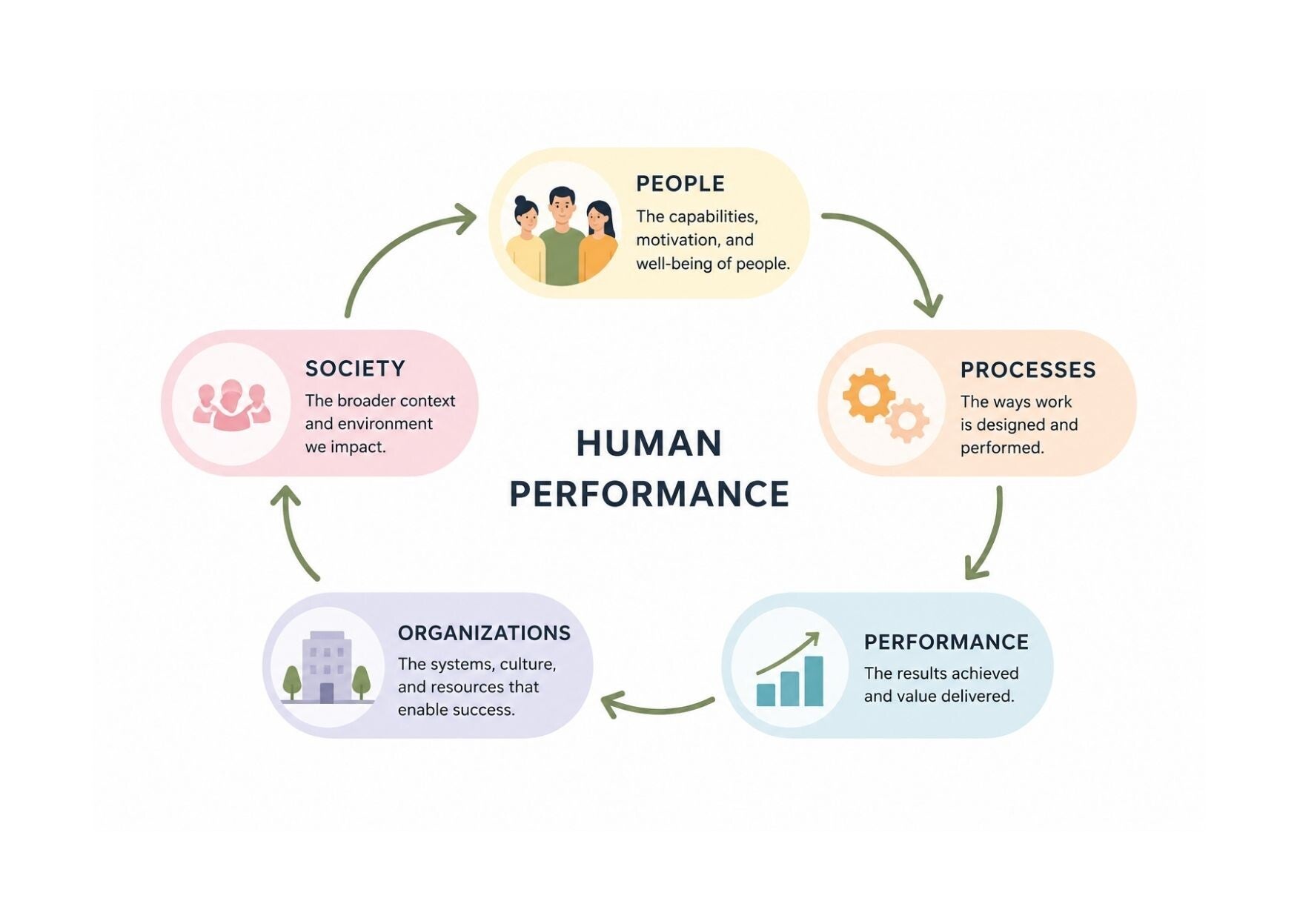
What is the HPT Model?
Human Performance Technology (HPT), also known as Human Performance Improvement (HPI), is the application of evidence-based practices to diagnose and improve workplace performance. The HPT Model is a responsive, adaptable, and accountable tool that helps ensure that organizational change is both systematic and systemic and can be sustained over the long term. Change management is integral to the process and is included at every stage of the model. To maximize results, it is best not to skip any steps in the model. When examining the simplified HPT Model, note that evaluation is continuous throughout the change process. Although organizations often evaluate change before implementation, this crucial step is frequently overlooked once the intervention is in place. In fact, only slightly more than 50 percent of organizations evaluate participants' behavioral changes and organizational outcomes post-implementation (Pulichino, 2007, as cited in Chyung, 2019, p. 7). Following the HPT Model, both linear and cyclic approaches lead to a thorough diagnosis of the business need or opportunity. The HPT Model was initially designed by William Deterline and Marc Rosenberg in 1992 and updated by Darlene M. Van Tiem, CPT, PhD., James L. Moseley, CPT, EdD, and Joan Conway Dessinger, CPT, EdD in 2004 and again in 2012 (VanTiem, Moseley, & Dessinger, 2012, pp. 10 & 12). Below is a simplified version of the HPT Model that we will expand upon in this text.