

High-uncertainty projects, which entail high rates of change, complexity, and risk, require techniques that enable adaptability, rapid response times, and frequent feedback loops.
What is Agile?
Agile is a mindset for approaching and executing projects. It uses multiple methods and frameworks depending on the project's goals and alignment with the Agile Manifesto. Four values align with the manifesto: individuals and interactions over processes and tools; working software over comprehensive documentation; customer collaboration over contract negotiation; and responding to change over following a plan (Project Management Institute, 2017). The highest priority is to deliver continuous value to the customer in short, regular intervals. These shortened work process cycles help mitigate risk, reduce waste, and enable quick responses to change, enabling continuous improvement.
Benefits of AI
Artificial intelligence (AI) helps teams quickly process and organize large amounts of data. AI can also assist teams with discovery by finding patterns, providing insights, and organizing them into categories. AI can also support backlog creation with user-centered artifacts such as personas and journey maps. Teams can then focus on high-value analysis instead of expending effort on mundane, time-consuming processes. AI can also generate hypotheses for further exploration and consideration, ensuring solutions tie back to the problem or need.
According to Matt Sigelman, incorporating AI into project management aids employee retention and creates an upskilled employee cohort; mitigates risk through more profound organizational expertise; and benefits the organization financially by enabling it to execute more projects (Project Management Institute, 2025, p. 9). Utilizing AI in the agile process makes sense, as it aligns with the values on which agile is based: accelerating analysis, enabling teams to operate in shorter increments, and delivering continuously. Teams can discover faster, collaborate more, and therefore focus on the customer.

(McKinsey, 2025)
Nearly two-thirds of organizations are still in the experimentation or piloting phase of scaling AI across the enterprise, with sixty-two percent experimenting with AI (McKinsey, 2025). Therefore, many organizations remain in the pilot phase of embedding AI across workflows and inadvertently forgo gains and benefits. Respondents who use AI across at least one business function reported improvements in company-wide qualitative outcomes. The top three are innovation, employee satisfaction, and customer satisfaction, with competitive differentiation in close fourth place (McKinsey, 2025).
Future of AI
Agentic AI is a goal-oriented AI system that uses large language models to plan, decide, and act independently to achieve organizational objectives. Developers of Agentic AI systems claim it provides “cost efficiency, revenue growth, and the ability to unlock the full potential of their talent” (Deloitte, 2025). Organizations are encouraged to adopt AI early and incrementally, so teams can adapt and integrate these autonomous systems into their daily tasks, thereby upskilling the workforce.
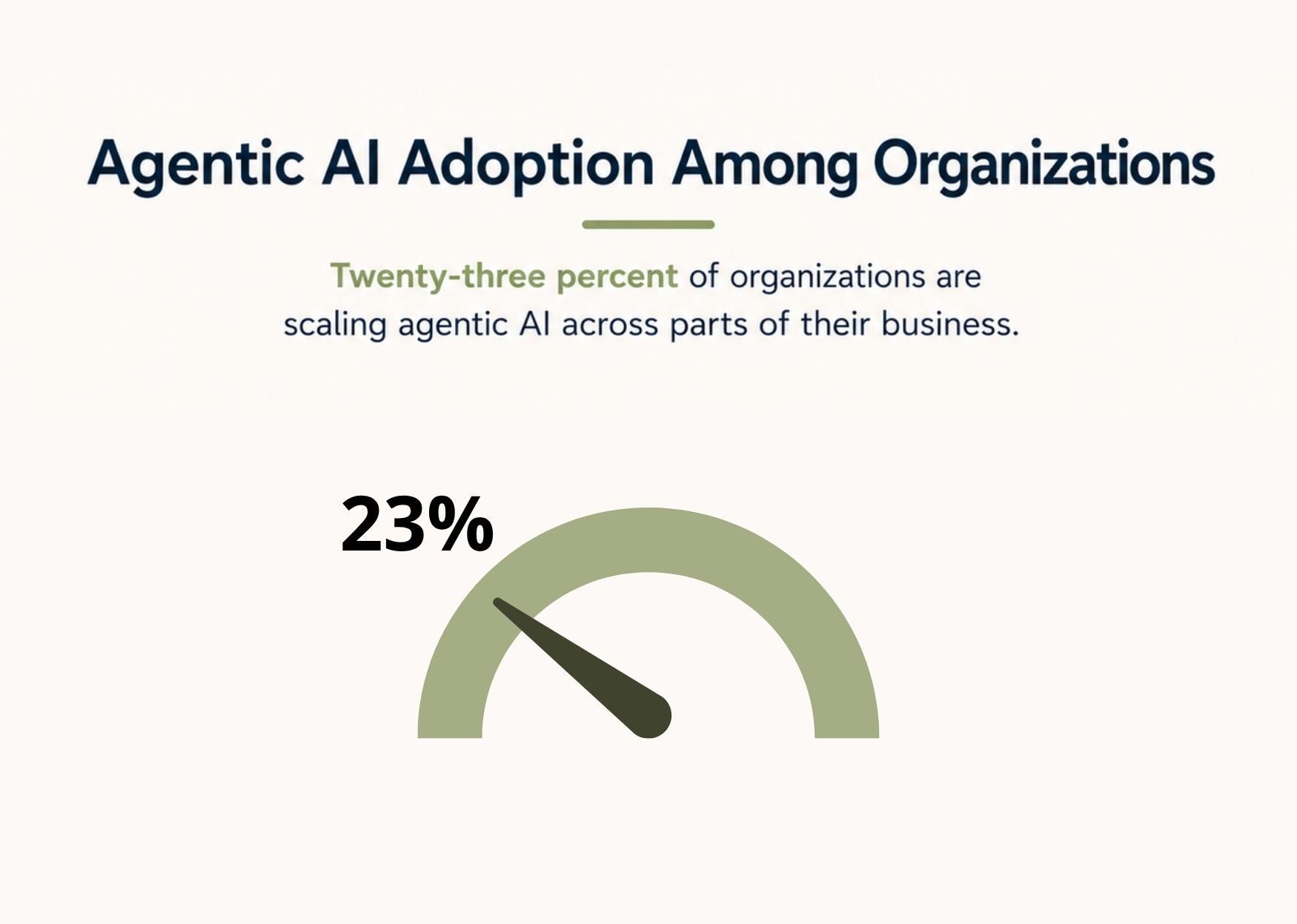
Twenty-three percent of organizations are scaling agentic AI across parts of their business (McKinsey, 2025). Moving forward, organizations need to ensure that the systems they implement align with the enterprise at each phase step. This can be done by assessing the organization's readiness to adopt, designing a rollout strategy for each business area, and establishing metrics to measure implementation success. Using agile to adopt and continuously grow AI within the organization provides a competitive advantage by enabling enterprises to maintain quality, scale, empower workers, and regularly prepare for ongoing change with adaptability. These capabilities will be critical in maintaining quality, trust, and cost as organizations shift from Gen AI to agentic AI.
Check out our article, Why 'Being Agile' Matters More Than Ever in 2026
Risks and Considerations of AI
Incorporating AI into work processes is not without issues. First, bias in AI training must be recognized, as it can lead to hypotheses and recommendations that may not be well-suited to the organization or project at hand. AI assumptions must be challenged, and decisions must be made as to which interventions take priority to be genuinely beneficial. Organizations should implement practices that encourage employees to report bias in AI algorithms (Shestakova, 2021, p. 10). Therefore, teams should be familiar with their data so that any AI errors can be identified and misdirection avoided. Organizations must remember that AI is a tool for human teams to utilize, not a replacement for human capital.
Second, organizations must consider privacy concerns. AI uses training data to train further, which can expose sensitive information elsewhere when it shares what it has learned with external organizations. This information can include strategic information such as new product ideas and long-term market plans. AI can also be vulnerable to external malicious attacks aimed at accessing private information. Organizations must provide employees with resources to use AI responsibly and ensure that platforms that handle sensitive data have safeguards in place.
Another consideration is the impact of AI use on human morale and momentum. Employee engagement and task performance outcomes are well documented to be positively correlated (Obuobisa-Darko, 2020, p. 16). Therefore, organizations need to be mindful of how AI is introduced and of the extent to which it is used in employees' tasks. Overreliance on AI outputs can reduce motivation to perform and overall output. Approaching implementation in phases is recommended to offset adverse outcomes.
Click the image to be redirected to the Artificial Intelligence Risk Management Framework (AI RMF 1.0) developed by the National Institute of Standards and Technology, part of the U.S. Department of Commerce.

Additional Articles
Why 'Being Agile' Matters More Than Ever
The relationship between Agile and project management (PM) has fundamentally changed over the years. What were once seen as competing approaches are now integrated into a single capability: delivering value in complex, fast-changing environments. Market volatility, rapid technological change, and evolving workforce expectations have forced a shift in how work gets done. Organizations that rely solely on traditional PM struggle to adapt. Those who adopt Agile practices without changing how they think and operate fall into what many call “Agile theater.”
What Project Managers Need to Know About the Future of Work
If you’ve been following headlines about artificial intelligence, you’ve probably seen two extremes: AI is either going to eliminate jobs at scale, or it’s going to unlock unlimited productivity. Neither of those narratives is particularly useful if you’re actually responsible for delivering work.
The Role of Artificial Intelligence in Universal Design for Learning
Artificial Intelligence (AI) is increasingly integrated into educational and workplace learning environments. Within instructional design and human performance technology (HPT), AI tools offer scalable mechanisms for personalization, automation, analytics, and accessibility. When viewed through the lens of Universal Design for Learning (UDL), AI has significant potential to operationalize flexibility at scale. UDL emphasizes proactive design for learner variability (Meyer, Rose, & Gordon, 2014). AI technologies—particularly adaptive learning systems, generative AI tools, learning analytics platforms, and intelligent tutoring systems—can help designers implement UDL principles more dynamically than static course design alone.
Universal Design for Learning in Instructional Design and Human Performance
Universal Design for Learning (UDL) is an educational framework grounded in cognitive neuroscience and inclusive design principles that aims to improve learning for all individuals by proactively reducing barriers to learning. Developed by the Center for Applied Special Technology (CAST), UDL extends the architectural concept of universal design—originally articulated by Mace (1985)—into educational contexts. Rather than retrofitting accommodations after barriers are encountered, UDL calls for designing learning environments that are flexible and accessible from the outset (Meyer, Rose, & Gordon, 2014).
Needs Assessment for Instructional Design
A needs assessment is a systematic process for identifying gaps between the current state and the desired state in performance, knowledge, skills, attitudes, or conditions, and using that information to make informed decisions about whether and how to intervene. Roger Kaufman defines needs assessment as "a process for identifying needs and placing them in priority order on the basis of what it costs to meet the need versus what it costs to ignore it" (Dean & Ripley, 2016, p. 43).
Agile Meets AI
Agile is a mindset for approaching and executing projects. It uses multiple methods and frameworks depending on the project's goals and alignment with the Agile Manifesto. Four values align with the manifesto: individuals and interactions over processes and tools; working software over comprehensive documentation; customer collaboration over contract negotiation; and responding to change over following a plan (Project Management Institute, 2017). The highest priority is to deliver continuous value to the customer in short, regular intervals. These shortened work process cycles help mitigate risk, reduce waste, and enable quick responses to change, enabling continuous improvement.
References
Deloitte (2025). Agentic enterprise 2028: A blueprint for cost savings, job creation, and faster growth through agentic AI. https://www.deloitte.com/content/dam/assets-zone3/us/en/docs/services/consulting/2025/agentic-ai-enterprise-2028.pdf
McKinsey (2025). The state of AI in 2025: Agents, innovation, and transformation. https://www.mckinsey.com/capabilities/quantumblack/our-insights/the-state-of-ai?utm_source=chatgpt.com#/
Obuobisa-Darko, T. (2020). Ensuring employee task performance: Role of employee engagement. Performance Improvement 59(8), 12-23.
Project Management Institute (2017). Agile Practice Guide.
Project Management Institute (2025). Enabling project management transformation with GenAI: The need for organizational support. https://www.pmi.org/-/media/pmi/documents/public/pdf/learning/genai_the-need-for-organizational-support_final-fix.pdf?rev=a1e6d5d9748b46d4b2a1db32f9c1c833
Shestakova, V. (2021). Best practices to mitigate bias and discrimination in artificial intelligence. Performance Improvement, 60(6), 6-11.
Add comment
Comments