

A needs assessment is a systematic process for identifying gaps between the current and desired states in performance, knowledge, skills, attitudes, or conditions, and using that information to make informed decisions about whether and how to intervene.
What is a Needs Assessment
A needs assessment is a systematic process for identifying gaps between the current state and the desired state in performance, knowledge, skills, attitudes, or conditions, and using that information to make informed decisions about whether and how to intervene. Roger Kaufman defines needs assessment as "a process for identifying needs and placing them in priority order on the basis of what it costs to meet the need versus what it costs to ignore it" (Dean & Ripley, 2016, p. 43).
"What is, and what should be."
- Jiddu Krishnamurti
Needs assessments often serve as the first step in a broader improvement effort—whether it concerns training, organizational change, or resource allocation. Therefore, needs assessment offers empirical grounding for intervention decisions, rather than relying on assumptions, intuition, or pressure to deliver training simply because someone “feels” or "thinks" it is needed. The emphasis on evidence-based decision-making is fundamental to both Human Performance Technology (HPT) and sound instructional design.
A needs assessment supports evidence-based decision-making by providing quantitative and qualitative data on actual gaps in performance or knowledge. This moves decision-making away from guesswork, assumptions, or pressure to proceed with training (Watkins et al., 2012, p. 10). With evidence, designers and stakeholders can make informed decisions about whether intervention is needed, what kind, and how to prioritize.
A needs assessment provides:
- A systematic approach for manageability, clarity, and thoroughness.
- Justification for decisions made related to the project.
- Replicable models or starting points for other projects within or outside of the department.
- A systemic approach that provides insight into problems and issues that lie outside of the department, yet contribute to the problem.
Needs Assessment vs. Needs Analysis
The terms “needs assessment” and “needs analysis” are often used interchangeably, yet there are some distinct differences between them. A needs assessment reveals a problem or opportunity; a needs analysis helps explain why the problem exists and whether a solution (if any) is warranted.
Needs Assessment
- The process of identifying and describing a gap between current and desired performance or conditions
- Often, a high-level process
- Can be organization-wide or system-wide
- Asks the questions:
- Is there a need?
- If so, what is it, and how important is it?
Needs Analysis
- Completed once a need has been identified
- Examines in greater depth:
- Why the gap exists
- Who is affected
- Which intervention (instructional or non-instructional) will appropriately address the gap
How a Needs Assessment Is Used in Instructional Design
In instructional design—whether for corporate training, adult education, or academic curricula—needs assessment plays a critical foundational role. It ensures that design efforts begin with data rather than assumptions and that interventions align with real performance or learning needs. Therefore, within instructional design, it is necessary to understand the learner's educational journey and to incorporate this objective in the data collection process (Stefaniak, 2021).
The Starting Point in Instructional Systems Approaches
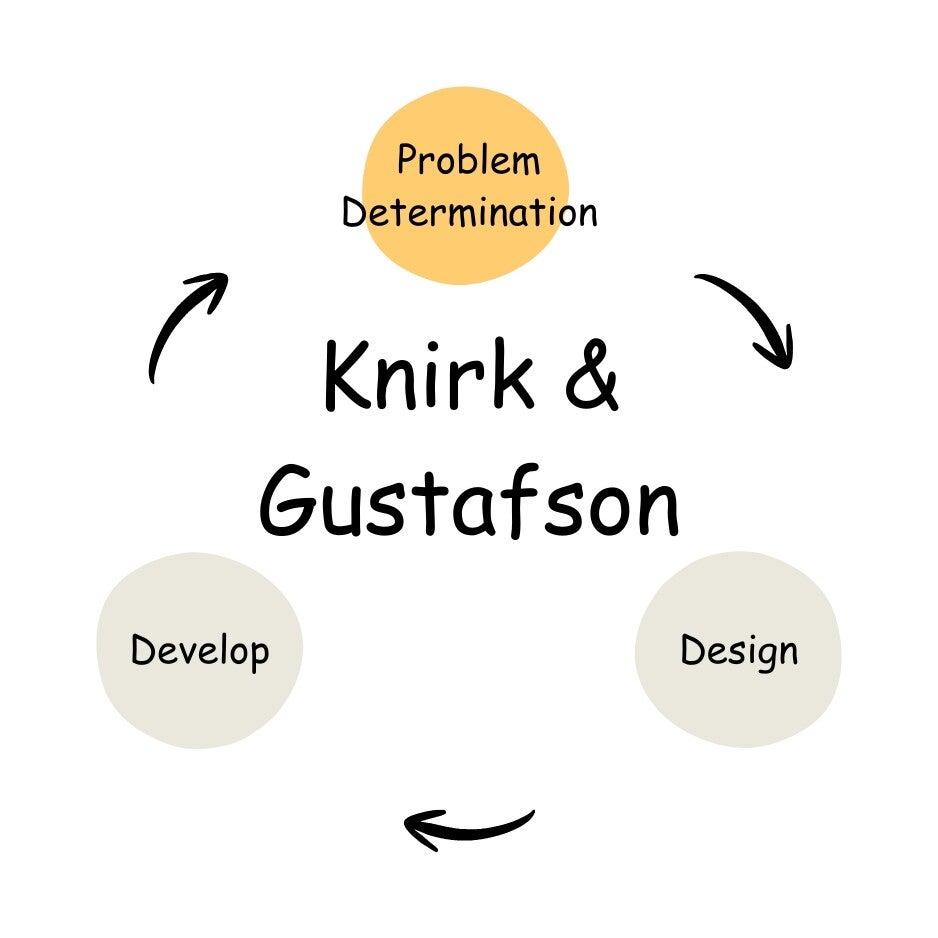
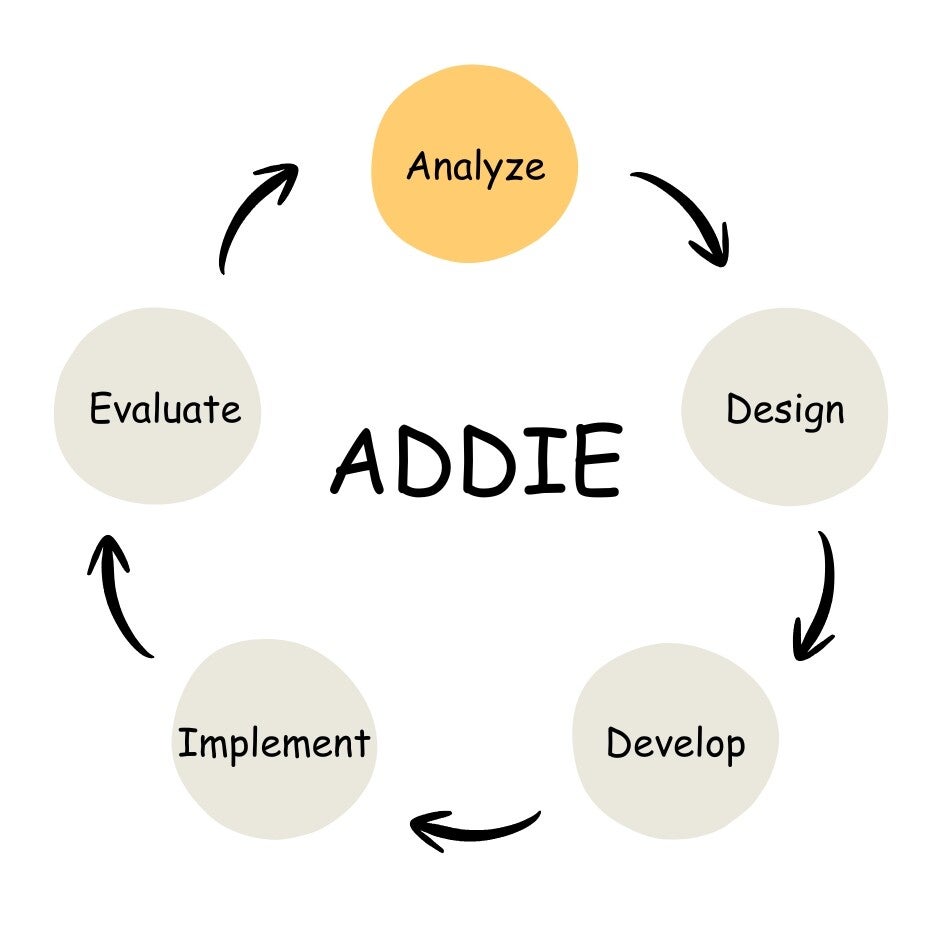
Most systematic instructional design models begin with an assessment or analysis phase. For example, the first stage of the Knirk & Gustafson Instructional Design Model is “Problem Determination,” which calls for a needs assessment or equivalent (Isman et al., 2005). Likewise, the ADDIE model begins with an analysis phase, which ideally includes a needs assessment if one has not already been conducted (Evans, n.d.).
Common Data-Gathering Tools
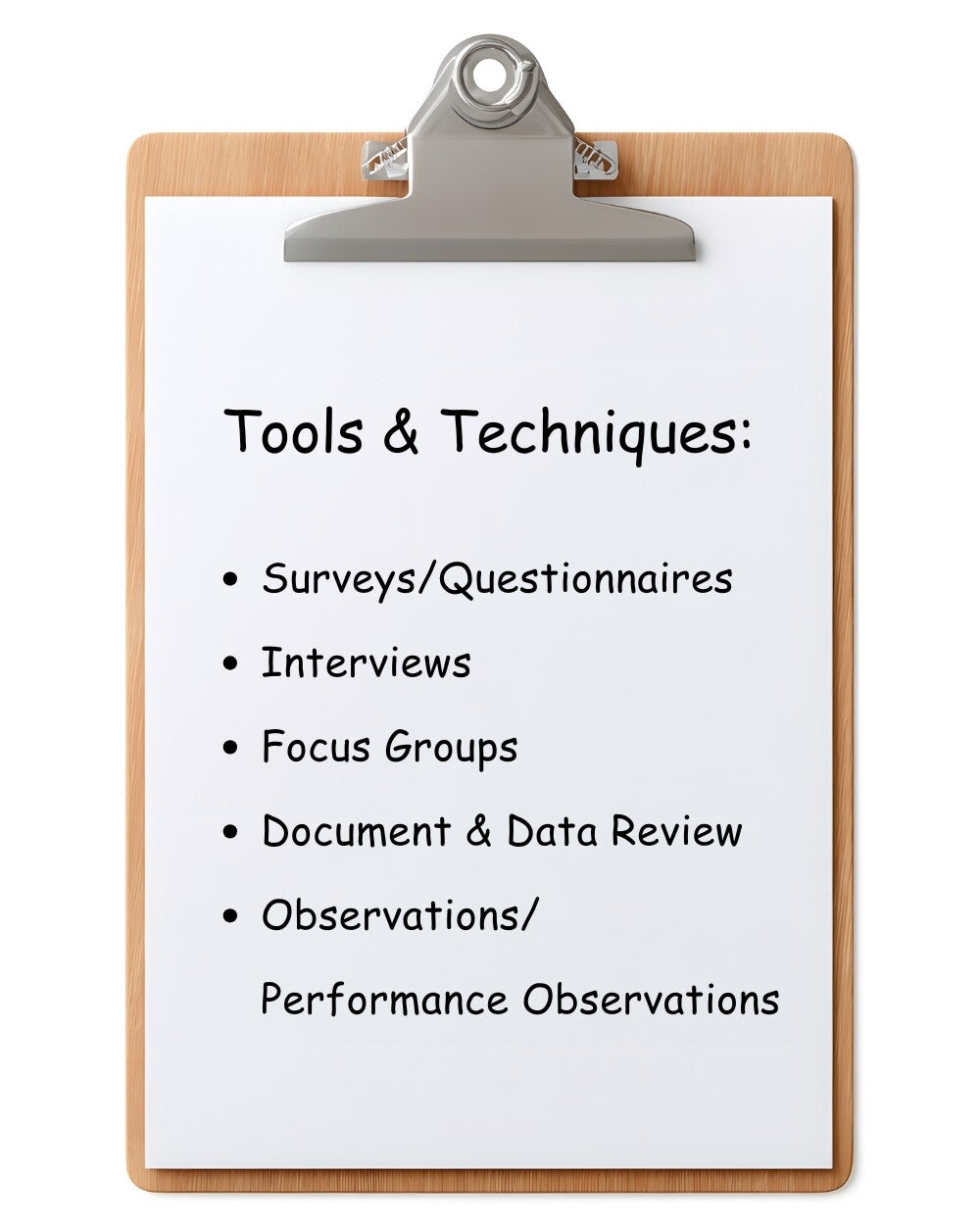
Here are common tools/techniques used in needs assessment, especially in instructional design. Which option is best depends on the situation and on whether answers are best obtained through questions or observation. Other factors to consider include how the respondent will feel most comfortable sharing, how familiar the assessors are with the assessment processes, which data format will best answer the questions, and whether the processes are within budget.
-
Surveys / Questionnaires: Widely used to collect data from many stakeholders — learners, employees, supervisors, clients, etc. Surveys can ask about perceived gaps in knowledge, skills, performance, attitudes, or resources.
- Interviews: One-on-one or structured interviews with stakeholders (managers, subject-matter experts, learners) to gather in-depth qualitative information about performance needs, context, constraints, and perceptions. Best for exploring nuanced issues that aren’t easily captured in surveys.
- Focus Groups: Group discussions with representative stakeholders to surface shared concerns, needs, opinions, and contextual factors. Useful to identify common themes and priorities.
- Document and Data Review: Analysis of existing organizational records — performance data, productivity metrics, error logs, incident reports, HR data, etc. These can reveal objective evidence of performance gaps or deficiencies. As an instructional designer, it is advisable to conduct an additional review of existing training materials (Stephaniak, 2021).
- Observations / Performance Observation: Direct observation of work processes, tasks, and performance in context (workplace, job environment, classroom). Useful to see real-world practices, behaviors, and performance — what people actually do versus what they say.
Prioritize Findings
After collecting and processing the data, there will likely be more than one need identified. Therefore, some questions to consider when deciding which needs to pursue are:
- Magnitude/Severity: How big is the problem, and how many people or departments are affected?
- Urgency/Risk: What are the consequences if nothing is done to address the problem? Are there any threats if something is done?
- Feasibility/Cost: Does the organization have the resources and expertise to address the problem? Is doing something sustainable?
- Effectiveness: What is the return on investment?
Best Practices of Needs Assessment
Utilizing best practices helps ensure that a needs assessment is rigorous, relevant, and actionable, and that it leads to effective instructional (or non-instructional) solutions.
1. Begin with a Clear Purpose and Scope (Pre-assessment Planning)
Before collecting any data, the needs assessment team should define the purpose, scope, boundaries, stakeholders, desired outcomes, and constraints (e.g., time, budget, and personnel). This helps prevent scope creep, confusion, and the collection of unnecessary/unusable data. This planning should also include which questions require answers (evaluation questions), which data sources to consult, which sampling methods (for surveys/interviews/observations) are appropriate, and how the data will be analyzed and used—i.e., a project plan for the needs assessment itself.
2. Use Multiple Data Sources and Methods (Triangulation)
Relying on a single method (e.g., a survey or interviews) risks bias and the omission of essential aspects of the situation. Combining qualitative and quantitative methods—such as surveys, interviews, performance data reviews, and observations—enhances the validity and reliability of findings and provides a richer, more holistic picture of needs. In addition, engaging diverse stakeholders (learners, instructors, managers, clients) helps surface multiple perspectives—needs from “below” (learners), “above” (management), and “sideways” (peers and other stakeholders). For instructional design, it is also necessary to understand the environment in which learners operate (internal and external), how they access resources in their work (acquisition and transfer of knowledge), and learner demographics/personas (Stephaniak, 2021). Using Gilbert's Six Boxes as a guide for data collection not only ensures a robust understanding of the learner's environment but also facilitates the collection of data that informs priority setting (Binder, 1998, p. 50).

3. Focus First on Needs — Not Solutions
A common mistake is to start thinking about solutions (e.g., "let's build a course") before fully understanding the needs. Best practice dictates postponing solution design until after needs are identified, which helps ensure that the intervention selected during the needs analysis truly addresses the root problem and that solutions are "value-explicit and change-driven" (Hawe, 1996, p. 477).
4. Create a Report
Document the findings, recommendations, and rationale of the assessment in a report, presentation, or both. The purpose of the report is to help senior management determine whether to proceed with a needs analysis. Include a summary of the data, the identified needs, and the list of priorities. Not only does the report help with buy-in, but it also serves as a reference should the organization decide to proceed. Therefore, ensuring that data are measurable, reliable, and relevant is of the utmost importance.
5. Involve Stakeholders
Regularly engage learners, managers, subject-matter experts, and instructors in the process to ensure that needs align with the organization's objectives. Keeping others involved in the process also helps build buy-in, should it be determined that a need is worth addressing, by fostering understanding of the need within the organization's context and constraints.
6. Be Flexible
Every organization and department within that organization differs. Therefore, what works for one assessment won't necessarily work for another. Be prepared to adapt the data collection techniques, the frameworks used, and the delivery of findings in the report. Also, consider stakeholders and choose them carefully. Allow the data to lead the conclusions, not the other way around, to ensure a positive impact.
For a more in depth look into change management, we suggest our article, What is the HPT Model?
Challenges and Risks
Conducting a thorough, multi-method needs assessment can be time-consuming and require resources (personnel, data access, stakeholder participation). In organizations under pressure to “just get training done,” there may be pressure to skip or shortcut the assessment phase.
Surveys may suffer from low response rates, bias, or inaccurate self-assessments; observations may miss key behaviors; performance records may be incomplete or fail to measure what truly matters. Document review may rely on outdated or irrelevant data. As with any research, data quality and validity are significant concerns.
When too much data is collected, or too many stakeholder perspectives are involved, analysis can become overwhelming; teams may struggle to prioritize or delay action while debating findings. Without careful planning and decision-making tools, needs assessment risks becoming an open-ended research project rather than a path to action.

Different stakeholders may hold incompatible views on the most essential needs. Consensus-building techniques (e.g., Delphi) help — but require skill, time, and facilitation.

In Summary
A needs assessment is a strategic, evidence-based, decision-support process that lays the foundation for effective instructional design (or other performance improvement solutions). When done well, it ensures that training or learning interventions are relevant, targeted, feasible, aligned with organizational goals, and capable of producing meaningful outcomes. The benefits make it a powerful tool that enables practitioners to tailor needs to context, scope, and resources. By applying best practices, instructional designers can maximize the value of a needs assessment.
Read more instructional design articles
The Role of Artificial Intelligence in Universal Design for Learning
Artificial Intelligence (AI) is increasingly integrated into educational and workplace learning environments. Within instructional design and human performance technology (HPT), AI tools offer scalable mechanisms for personalization, automation, analytics, and accessibility. When viewed through the lens of Universal Design for Learning (UDL), AI has significant potential to operationalize flexibility at scale. UDL emphasizes proactive design for learner variability (Meyer, Rose, & Gordon, 2014). AI technologies—particularly adaptive learning systems, generative AI tools, learning analytics platforms, and intelligent tutoring systems—can help designers implement UDL principles more dynamically than static course design alone.
Universal Design for Learning in Instructional Design and Human Performance
Universal Design for Learning (UDL) is an educational framework grounded in cognitive neuroscience and inclusive design principles that aims to improve learning for all individuals by proactively reducing barriers to learning. Developed by the Center for Applied Special Technology (CAST), UDL extends the architectural concept of universal design—originally articulated by Mace (1985)—into educational contexts. Rather than retrofitting accommodations after barriers are encountered, UDL calls for designing learning environments that are flexible and accessible from the outset (Meyer, Rose, & Gordon, 2014).
Needs Assessment for Instructional Design
A needs assessment is a systematic process for identifying gaps between the current state and the desired state in performance, knowledge, skills, attitudes, or conditions, and using that information to make informed decisions about whether and how to intervene. Roger Kaufman defines needs assessment as "a process for identifying needs and placing them in priority order on the basis of what it costs to meet the need versus what it costs to ignore it" (Dean & Ripley, 2016, p. 43).
Storyboarding for Scenario-Based eLearning Objects
Storyboards are visual representations of how an e-learning object will appear and function as an end product, serving as a communication document, a risk-management tool, and a project management tool that improves communication and engagement among all project members (Canon & Harding, 2017). Storyboards identify constraints, goals, scope, and changes, helping mitigate risk by monitoring these factors. Communication is maintained by keeping all members, including subject matter experts (SMEs) and stakeholders, informed throughout the project, validating it through the sign-off process. Storyboards expedite the build process by providing the build team with all necessary information, enabling the e-learning project to be completed within scope and schedule (Cannon & Harding, 2017; PMBOK Guide, 2017). Storyboards add value to both the instructional designer (ID) and the organization by streamlining processes and ensuring quality control. Lastly, storyboards enable collaboration with clients and stakeholders by providing a tangible deliverable that can be customized to meet project needs.
References
Binder, C. (1998). The six boxes: A descendent of Gilbert's behavior engineering model. Performance Improvement July/August(1998) pp. 48-52. https://www.sixboxes.com/_customelements/uploadedResources/SixBoxes.pdf
Dean, P.J. & Ripley, D.E. (2016). Chapter 9: Roger Kaufman, PhD: The needs assessment audit. Performance Improvement 55(7) pp. 43-46. https://drive.google.com/file/d/1-_pcopg9xT1Mx380M0Z95i6otT82NNJb/preview
Evans, L. (n.d.). The ADDIE model for instructional design (+pros/cons & faqs). University of SanDiago. https://onlinedegrees.sandiego.edu/addie-model-instructional-design/#:~:text=All%20instructional%20design%20models%20follow%20some%20variation,Evaluating%20the%20outcomes%20of%20implementing%20the%20solution.
Hawe, P. (1996). Needs assessment must become more change-focused. Australian and New Zealand Journal of Public Health 20(5) pp. 473-478. https://onlinelibrary.wiley.com/doi/epdf/10.1111/j.1467-842X.1996.tb01624.x
Ìsman, A., Çağlar, M, Dabaj, F., & Ersözlü, H. (2005). A new model for the world of instructional design: A new model. The Turkish Online Journal of Education 4(3) Article 6. https://files.eric.ed.gov/fulltext/ED495698.pdf
Stefaniak, J. E. (2021). Determining environmental and contextual needs. In J. K. McDonald and R. E. West (Eds.) Design for learning: Principles, processes, and praxis (pp. 53-65). Brigham Young University IP&T Department. https://edtechbooks.org/id/needs_analysis
Watkins, R., Meiers, M.W., & Visser, Y.L. (2012). A guide to assessing needs: Essential tools for collecting information, making decisions, and achieving development results. The World Bank. https://documents1.worldbank.org/curated/en/644051468148177268/pdf/663920PUB0EPI00essing09780821388686.pdf?utm_source=chatgpt.com
Add comment
Comments