

Universal design for learning is a proactive learning framework that reduces barriers to learning by drawing on cognitive neuroscience and inclusive design principles.
Universal Design for Learning (UDL) is an educational framework grounded in cognitive neuroscience and inclusive design principles that aims to improve learning for all individuals by proactively reducing barriers to learning. Developed by the Center for Applied Special Technology (CAST), UDL extends the architectural concept of universal design—originally articulated by Mace (1985)—into educational contexts. Rather than retrofitting accommodations after barriers are encountered, UDL calls for designing learning environments that are flexible and accessible from the outset (Meyer, Rose, & Gordon, 2014).
Within instructional design (ID) and human performance technology (HPT), UDL provides a proactive systems approach to learner variability. While traditional instructional design models such as ADDIE emphasize systematic planning and alignment (Branch, 2009), UDL adds a layer of intentional variability planning: it assumes learner differences are the norm rather than the exception.
Theoretical Foundations
UDL is grounded in research from cognitive neuroscience, particularly work describing three major learning networks in the brain (Rose & Meyer, 2002; Meyer et al., 2014):
-
Affective networks – What motivates learners and sustains persistence?
-
Recognition networks – How do learners perceive and comprehend information?
-
Strategic networks – How do learners demonstrate what they know?
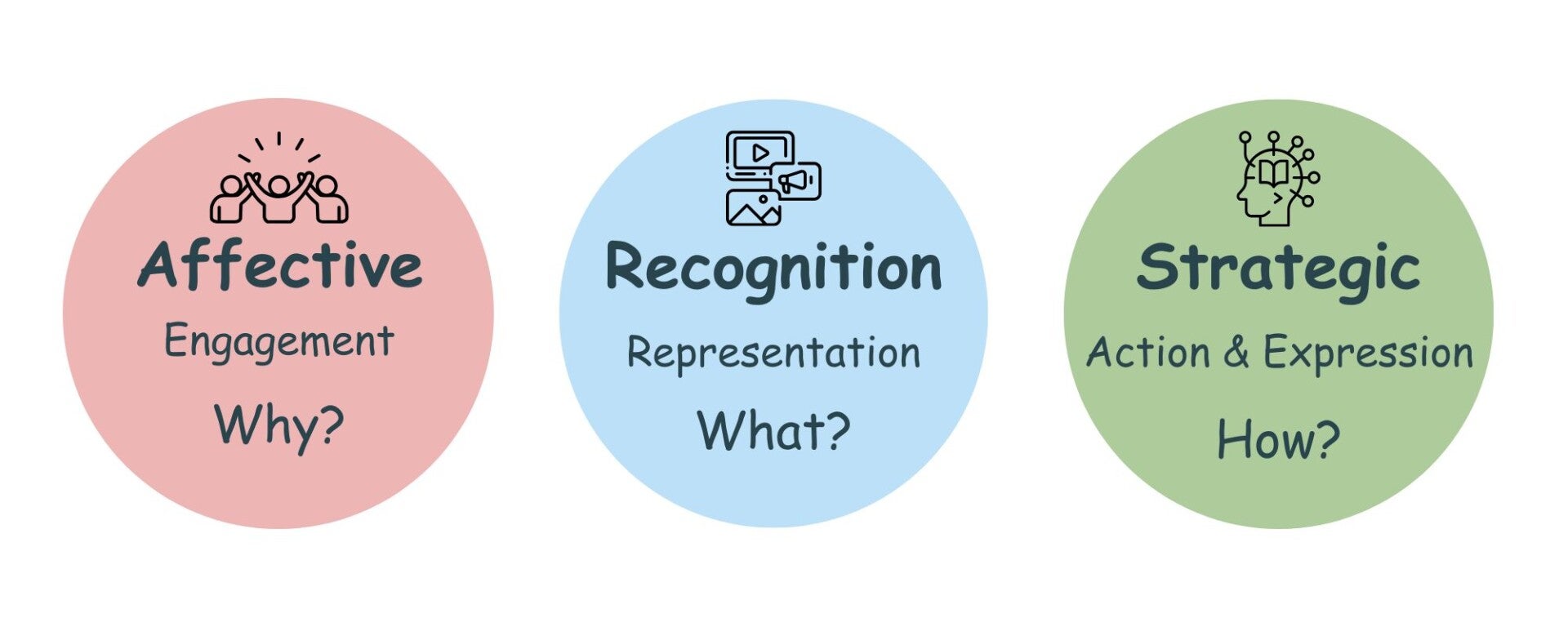
The core assumption underlying UDL is that learner variability is predictable and systematic. Variability may stem from culture, language, cognitive profiles, prior knowledge, motivation, disability status, technology access, and context. Therefore, designing for an “average learner” is both ineffective and inequitable (Meyer et al., 2014).
UDL Is Proactive Design
UDL differs from individualized accommodation models by shifting design upstream. Instead of waiting for barriers to appear, UDL anticipates variability and embeds flexibility into the original design.
For example:
-
Text materials may include audio options.
-
Assignments may allow multiple demonstration formats (written, oral, visual).
-
Activities may include varied engagement strategies.
UDL is not about “making things easier,” but about removing unnecessary barriers while maintaining high expectations (Rose & Meyer, 2002).
UDL vs. Accessibility: Clarifying the Difference
UDL and accessibility are often conflated, but they are conceptually distinct. Accessibility typically refers to compliance with standards that ensure individuals with disabilities can access content. Accessibility is often legally driven (e.g., ADA compliance in the United States) and reactive—implemented to meet minimum access standards. UDL goes beyond minimum compliance. It focuses on optimizing learning for all learners by providing flexibility and choice in representation, engagement, and expression (Meyer et al., 2014).
Accessibility
- Focused on disability access
- Often compliance-driven
- Reactive accommodations
- Minimum standards
UDL
- Focused on learner variability
- Learning-optimization driven
- Proactive design
- Flexible pathways
Key Distinctions
- Accessibility ensures learners can access content.
- UDL ensures learners can learn effectively from that content.
-
Accessibility is necessary but not sufficient for UDL. UDL incorporates accessibility but extends beyond it.
How UDL Is Used
Integration with Instructional Design Models
UDL integrates most naturally into the Analysis and Design phases of models like ADDIE (Branch, 2009).
During Analysis:
-
Designers identify learner variability.
-
Designers assess environmental and technological constraints.
-
Designers examine motivational and engagement factors.
During Design:
-
Designers intentionally build multiple pathways for representation and expression.
-
Designers ensure materials are accessible and flexible.
-
Designers align objectives with a variety of assessment formats.
UDL in Needs Assessment and Performance Analysis
Within HPT, performance gaps often stem from environmental barriers rather than individual deficiencies (Gilbert, 1978; Rummler & Brache, 1995). UDL aligns with systems thinking by recognizing that poor performance may result from rigidity or design problems rather than learner limitations.
For example:
-
If training assumes strong reading skills, learners with language barriers may underperform—not because of competence, but because of the format.
-
If assessments require only timed written responses, learners with processing variability may appear less competent.
UDL in Course and Training Development
In practice, UDL may include:
Representation
-
Text + audio narration
-
Infographics + detailed explanations
-
Captioned video + transcripts
Action & Expression
-
Multiple assessment options
-
Flexible deadlines (when appropriate)
-
Scaffolding and templates
Engagement
-
Choice in topics
-
Real-world problem-solving
-
Collaborative options
-
Gamified elements
Benefits of Using UDL in Instructional Design

Improved Learning Outcomes
Research suggests that flexible instructional design improves comprehension and persistence (Meyer et al., 2014). When learners can access content in ways aligned with their strengths, cognitive load decreases (Sweller, 2011), improving transfer and retention.

Increased Learner Engagement
UDL explicitly addresses affective networks. Motivation and engagement are critical predictors of persistence and transfer (Keller, 2010). By incorporating choice and relevance, UDL aligns with motivational design models.

Alignment with Systems Thinking in HPT
UDL aligns with Gilbert’s (1978) Behavior Engineering Model by addressing environmental supports and design constraints rather than blaming individuals.

Organizational Equity and Inclusion
In corporate and higher education settings, UDL supports diversity, equity, and inclusion initiatives by normalizing flexibility.
Reduced Need for Individual Accommodations
Proactive design reduces retrofitting. This increases efficiency and equity.
Challenges and Limitations
-
Increased design time initially
-
Need for faculty/designer training
-
Risk of superficial implementation
-
Institutional resistance
Learn how AI and UDL work together in our article, The Role of Artificial Intelligence (AI) in Universal Design for Learning (UDL)
Best Practices for Implementing UDL in Instructional Design
In Conclusion
Universal Design for Learning represents a shift from reactive accommodation to proactive inclusive design. It differs from accessibility by focusing not merely on access, but on optimizing learning outcomes through intentional variability planning.
When integrated into instructional design and human performance technology, UDL enhances engagement, equity, and effectiveness. Its alignment with systems thinking and motivational design makes it particularly relevant for contemporary educational and workplace learning environments.
In an increasingly diverse and technologically mediated world, UDL provides a research-informed framework for designing learning experiences that are flexible, equitable, and performance-oriented. For additional information on AI-enabled UDL, click here.
Check out other topics that interest you
Why 'Being Agile' Matters More Than Ever
The relationship between Agile and project management (PM) has fundamentally changed over the years. What were once seen as competing approaches are now integrated into a single capability: delivering value in complex, fast-changing environments. Market volatility, rapid technological change, and evolving workforce expectations have forced a shift in how work gets done. Organizations that rely solely on traditional PM struggle to adapt. Those who adopt Agile practices without changing how they think and operate fall into what many call “Agile theater.”
What Project Managers Need to Know About the Future of Work
If you’ve been following headlines about artificial intelligence, you’ve probably seen two extremes: AI is either going to eliminate jobs at scale, or it’s going to unlock unlimited productivity. Neither of those narratives is particularly useful if you’re actually responsible for delivering work.
The Role of Artificial Intelligence in Universal Design for Learning
Artificial Intelligence (AI) is increasingly integrated into educational and workplace learning environments. Within instructional design and human performance technology (HPT), AI tools offer scalable mechanisms for personalization, automation, analytics, and accessibility. When viewed through the lens of Universal Design for Learning (UDL), AI has significant potential to operationalize flexibility at scale. UDL emphasizes proactive design for learner variability (Meyer, Rose, & Gordon, 2014). AI technologies—particularly adaptive learning systems, generative AI tools, learning analytics platforms, and intelligent tutoring systems—can help designers implement UDL principles more dynamically than static course design alone.
Universal Design for Learning in Instructional Design and Human Performance
Universal Design for Learning (UDL) is an educational framework grounded in cognitive neuroscience and inclusive design principles that aims to improve learning for all individuals by proactively reducing barriers to learning. Developed by the Center for Applied Special Technology (CAST), UDL extends the architectural concept of universal design—originally articulated by Mace (1985)—into educational contexts. Rather than retrofitting accommodations after barriers are encountered, UDL calls for designing learning environments that are flexible and accessible from the outset (Meyer, Rose, & Gordon, 2014).
Needs Assessment for Instructional Design
A needs assessment is a systematic process for identifying gaps between the current state and the desired state in performance, knowledge, skills, attitudes, or conditions, and using that information to make informed decisions about whether and how to intervene. Roger Kaufman defines needs assessment as "a process for identifying needs and placing them in priority order on the basis of what it costs to meet the need versus what it costs to ignore it" (Dean & Ripley, 2016, p. 43).
Agile Meets AI
Agile is a mindset for approaching and executing projects. It uses multiple methods and frameworks depending on the project's goals and alignment with the Agile Manifesto. Four values align with the manifesto: individuals and interactions over processes and tools; working software over comprehensive documentation; customer collaboration over contract negotiation; and responding to change over following a plan (Project Management Institute, 2017). The highest priority is to deliver continuous value to the customer in short, regular intervals. These shortened work process cycles help mitigate risk, reduce waste, and enable quick responses to change, enabling continuous improvement.
References
Branch, R. M. (2009). Instructional design: The ADDIE approach. Springer.
Gilbert, T. F. (1978). Human competence: Engineering worthy performance. McGraw-Hill.
Keller, J. M. (2010). Motivational design for learning and performance: The ARCS model approach. Springer.
Mace, R. L. (1985). Universal design: Barrier free environments for everyone. Designers West, 33(1), 147–152.
Meyer, A., Rose, D. H., & Gordon, D. (2014). Universal design for learning: Theory and practice. CAST Professional Publishing.
Rose, D. H., & Meyer, A. (2002). Teaching every student in the digital age: Universal design for learning. Association for Supervision and Curriculum Development (ASCD).
Rummler, G. A., & Brache, A. P. (1995). Improving performance: How to manage the white space on the organization chart (2nd ed.). Jossey-Bass.
Sweller, J. (2011). Cognitive load theory. Psychology of Learning and Motivation, 55, 37–76. https://doi.org/10.1016/B978-0-12-387691-1.00002-8
Add comment
Comments