

Organizations are no longer operating in stable environments. Project management and agile ways of working have converged into critical drivers of performance, adaptability, and sustained success.
The relationship between Agile and project management (PM) has fundamentally changed over the years. What were once seen as competing approaches are now integrated into a single capability: delivering value in complex, fast-changing environments. Market volatility, rapid technological change, and evolving workforce expectations have forced a shift in how work gets done. Organizations that rely solely on traditional PM struggle to adapt. Those who adopt Agile practices without changing how they think and operate fall into what many call “Agile theater.”
Why 2026 Is a Defining Moment for Agility
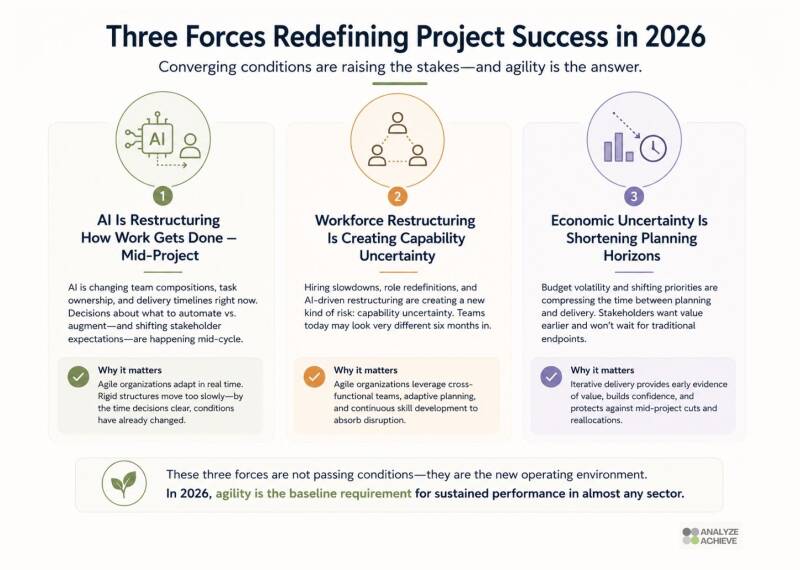
Organizational agility has always mattered. But the conditions of 2026 have made it non-negotiable in a way that previous years did not. Three converging forces are raising the stakes for organizations that have been slow to move beyond process-level agile adoption.
AI Is Restructuring How Work Gets Done — Mid-Project
Artificial intelligence is no longer a future consideration for most organizations — it is actively changing team compositions, task ownership, and delivery timelines right now. Project managers and team leads are navigating AI tool introductions mid-cycle, decisions about which roles to automate versus augment, and stakeholder expectations that are shifting faster than project charters can keep up with.
Organizations with genuine agility — decentralized decisions, iterative planning, continuous feedback — are absorbing these changes without losing momentum. Organizations still dependent on rigid annual plans and layered approval structures are finding that by the time a decision clears, the conditions that prompted it have already changed.
Workforce Restructuring Is Creating Capability Uncertainty
Hiring slowdowns, role redefinitions, and team restructuring driven by AI investment are creating a new kind of project risk: capability uncertainty. Teams that existed at the start of a project may look significantly different six months in. Skills that were assumed to be available may shift or disappear.
Agile organizations are better positioned to absorb this disruption because they are already built around adaptive planning, cross-functional teams, and continuous skill development embedded in their work. Brittle project structures that assume stable team compositions have much less room to absorb mid-course changes.
Economic Uncertainty Is Shortening Planning Horizons
Budget volatility, shifting investment priorities, and pressure to demonstrate returns more quickly are narrowing the window between planning and delivery. Stakeholders want to see value earlier and are less willing to wait for a traditional project endpoint to assess whether effort was well spent.
Iterative delivery — one of the core practices of genuine agility — directly addresses this pressure. When teams deliver value in increments rather than at the end of a long cycle, stakeholders have earlier evidence to evaluate, adjust, and continue funding with confidence. Organizations that cannot demonstrate incremental value are increasingly vulnerable to mid-project cancellations and budget reallocations.
Together, these three forces are not passing conditions — they are the new operating environment. Agility is no longer a competitive advantage reserved for tech companies or early adopters. In 2026, it is the baseline requirement for sustained performance in almost any sector.
You might also like, What Project Managers Need to Know About the Future of Work
Why Agile Transformations Fail
Understanding why Agile transformations fall short is the first step toward avoiding the same traps. Most failures share a recognizable pattern — and recognizing them early can save an organization significant time, money, and credibility.
- Leadership buy-in gaps. Agile transformations that are sponsored but not modeled by leadership rarely take hold. When senior leaders authorize agile processes for their teams but continue to make top-down decisions, maintain lengthy approval chains, and measure success through traditional outputs, they send a clear signal: the old way still wins. Teams adapt accordingly and perform agile rather than become agile.
- Tooling without culture change. Adopting Jira, Confluence, or any sprint management platform is not a transformation — it's a software purchase. When organizations invest heavily in agile tools but don't address how decisions are made, how conflicts are resolved, or how learning is shared, the tools become digital versions of the very rigid processes they were meant to replace.
- Scaling too fast. Many organizations successfully pilot Agile on one team, then immediately attempt to scale it enterprise-wide. Without first understanding why it worked in that context — the team dynamics, the leadership support, the type of work — scaling often produces inconsistency, confusion about which framework applies where, and eventual abandonment.
- Framework rigidity. Ironically, agile transformations sometimes fail because organizations follow frameworks too strictly. Scrum, SAFe, and Kanban are starting points, not prescriptions. When teams are penalized for deviating from a framework rather than encouraged to adapt it to their context, the framework itself becomes the obstacle to agility.
- Skipping the cultural foundation. Agile depends on psychological safety — the belief that team members can raise concerns, surface problems early, and admit uncertainty without professional risk. Organizations that implement Agile practices without first building that foundation often find that retrospectives become performative, blockers go unreported until they become crises, and continuous improvement never actually happens.
Recognizing these failure modes isn't a reason to avoid agile transformation — it's a reason to approach it deliberately, with as much attention paid to how people think and decide as to which processes and tools get adopted.
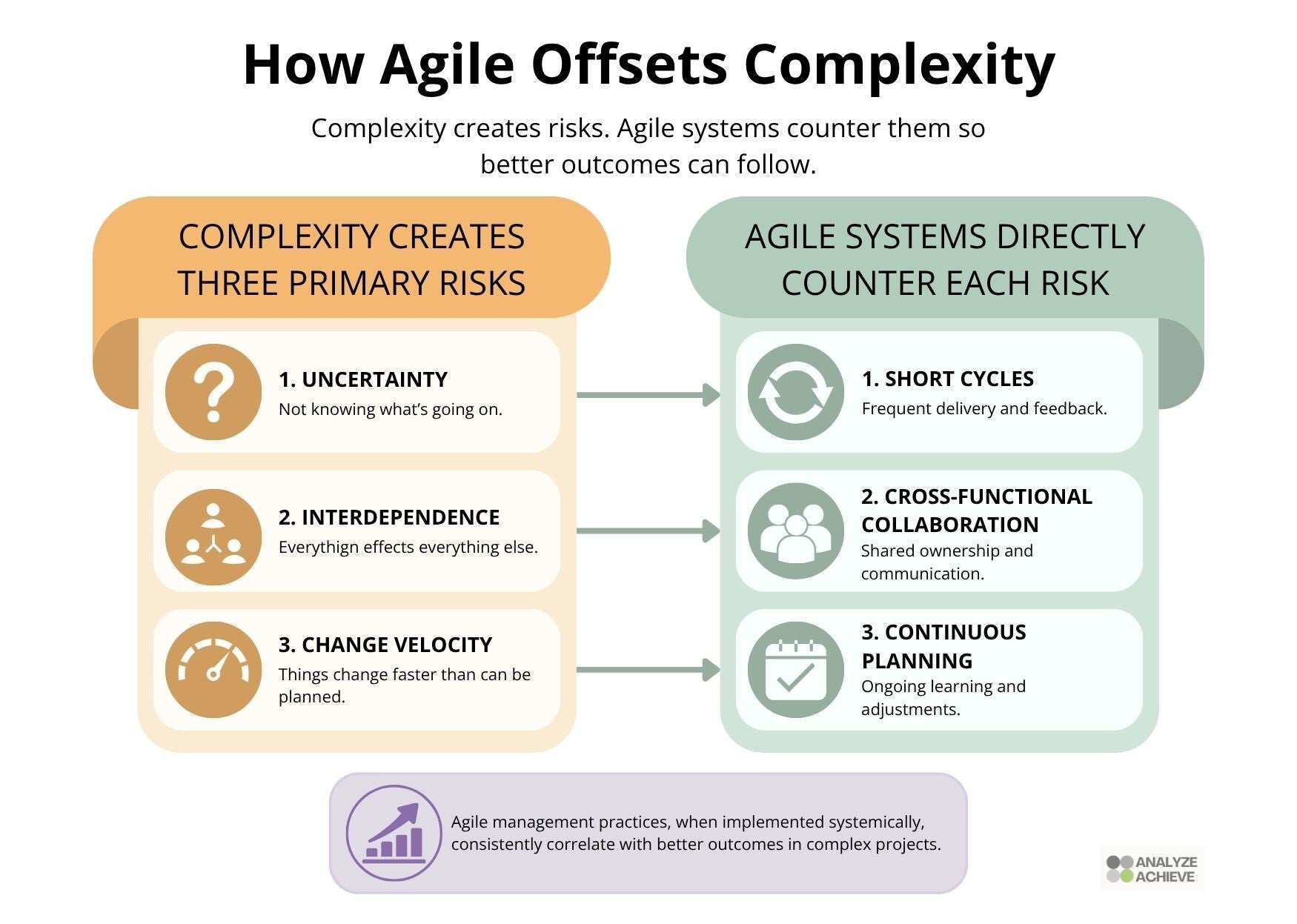
Implementing Agile management practices has been shown to offset the negative impact of project complexity on project success (Muhammad et al., 2021). The difference between success and stagnation comes down to one idea: High-performing organizations are not just practicing agility—they are agile systems. Project complexity isn’t going away. If anything, it’s accelerating—more stakeholders, tighter timelines, evolving requirements, and now AI layered into workflows. The typical response is to try to control complexity with more structure, more documentation, more approvals. However, that approach breaks under pressure. Data consistently shows that organizations that implement agile management practices don’t eliminate complexity—they absorb and adapt to it more effectively. That’s why Agile practices are strongly associated with higher project success rates, even in highly complex environments.
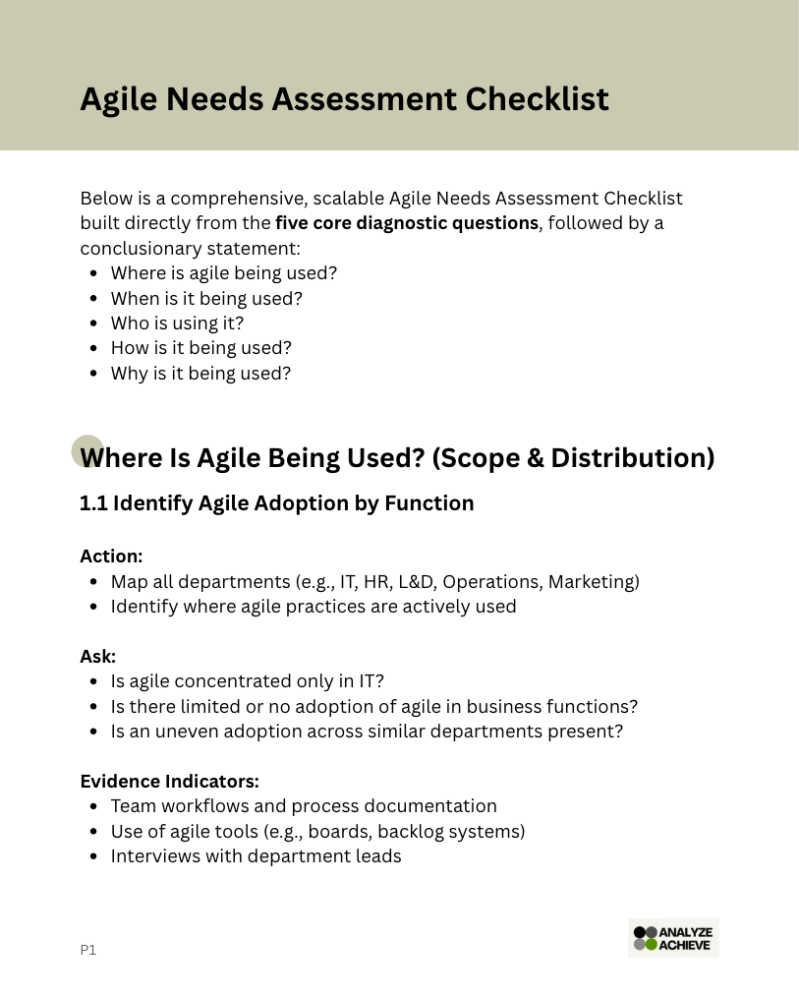
Scroll down to download our FREE Agile Needs Assessment Checklist

What is Agile
Agile is an operating philosophy or mindset grounded in adaptability, iterative learning, and continuous value delivery. It focuses on delivering small, incremental changes to a product rather than a complete overhaul. Organizations adopting Agile at scale report improved responsiveness, collaboration, and product quality (Dikert et al., 2016).
- Originated in software, now enterprise-wide
- Emphasizes responsiveness over rigid planning
- Focuses on speed, learning, and customer value
Core Agile Principles
- Flexibility: Adapt efficiently to change, whether it arises from customer feedback or evolving market conditions.
- Customer Satisfaction: Engage customers throughout the development process to ensure the final product meets their needs.
- Collaboration: Encourage teamwork and communication among stakeholders, developers, and customers.
- Continuous Improvement: Regularly assess processes and outcomes to improve team performance.
What is Project Management
PM is the structured discipline of planning, executing, and delivering work to achieve specific goals within constraints (scope, time, cost, quality). It involves defining project goals, setting deadlines, allocating resources, and managing risks to ensure project success.
- Traditionally associated with predictive (waterfall) models
- Increasingly hybridized with adaptive approaches
- Focus: governance, alignment, delivery reliability
Why Project Management Is Critical
- Goal Alignment: Clearly define project objectives and align them with organizational goals.
- Resource Management: Optimize the use of resources, including time, budget, and personnel.
- Risk Management: Identify potential risks and develop strategies to mitigate them.
- Quality Assurance: Ensure the project meets predefined quality standards and delivers value.
Agile Project Management
The hybrid approach of Agile and PM enables rigorous planning and resource management while remaining adaptable to change and customer needs. Modern project success increasingly depends on integrating agile and adaptive approaches, and organizations that blend predictive and agile approaches are more likely to meet business goals and adapt to change. (PMI, 2023).
- Provides structure and governance
- Aligns work to strategic goals
- Ensures accountability and delivery
Benefits of Combining Techniques
- Enhanced Flexibility: Agile's adaptability complements PM's structured planning, allowing teams to pivot efficiently while staying aligned with project goals.
- Improved Communication: Open channels fostered by agile enhance structured PM reporting, leading to better stakeholder engagement.
- Increased Efficiency: Combining iterative processes with detailed planning helps in timely delivery and resource optimization.
Why Agile Project Management Is Increasing in Importance
Organizations Are Operating in Constant Change
Market conditions shift rapidly, and static plans fail quickly.
- Agile enables faster response
- PM ensures controlled execution
Together, they create structured adaptability.
Human Performance Drives Results
Modern work depends on collaboration, feedback, and rapid learning cycles. agile environments naturally support these through:
- Retrospectives
- Iterations
- Continuous feedback loops
Proven Business Outcomes
Organizations using Agile PM practices report:
- Faster time-to-market
- Improved customer satisfaction
- Higher success rates
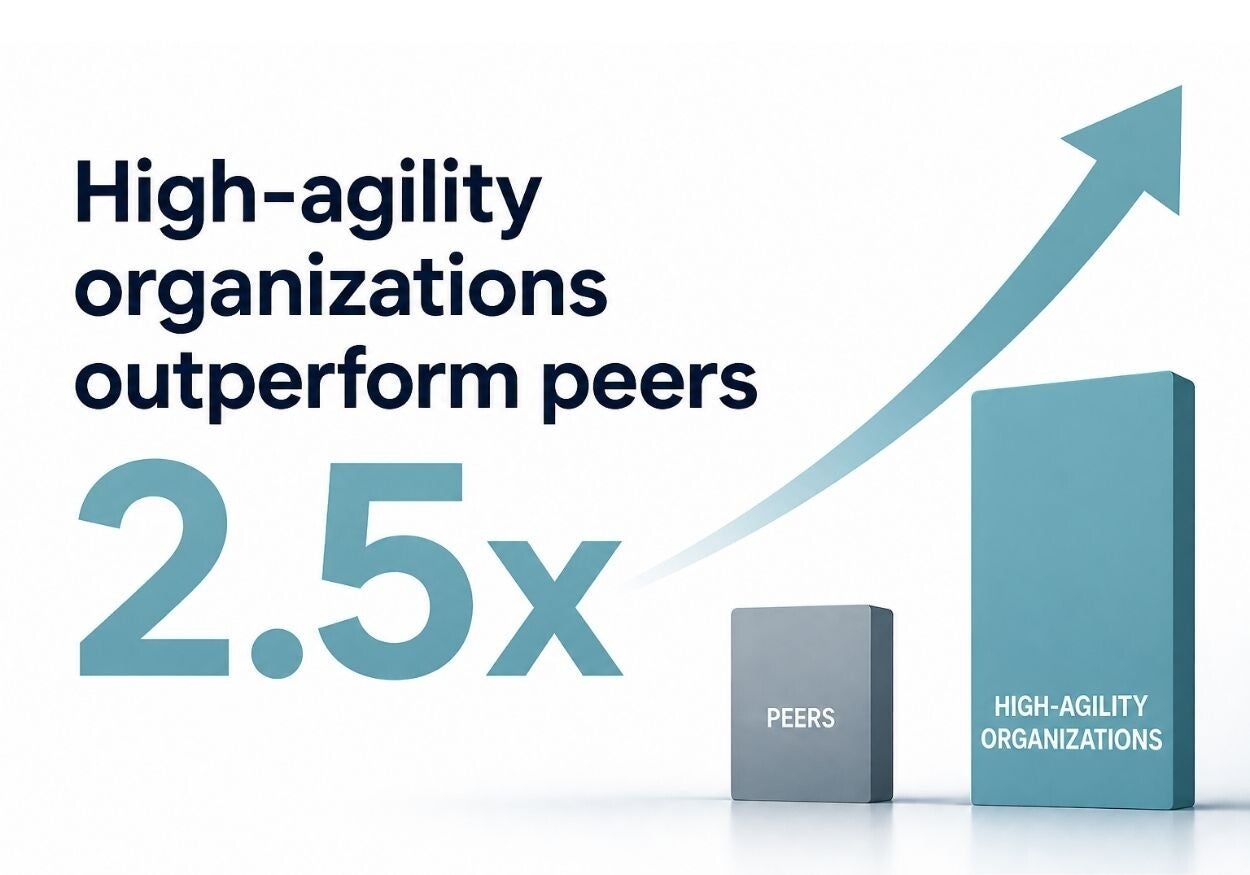
High-agility organizations are significantly more likely to outperform competitors (PMI, 2023).
Doing Agile vs. Being Agile
Simply "doing agile" leaves an organization without any real change in decision-making or culture. Incorporating Sprints or Agile terminology into meetings won't make an organization quick to adapt to change. Rigidly following frameworks that enforce processes on the workforce also stand in the way of progress.
The difference shows up most clearly in everyday behaviors and decisions:
- A team doing agile holds daily standups but uses them to report status upward. An agile team uses standups to surface blockers and self-organize to solve them — no manager required.
- A team doing agile completes sprints on schedule, but ships features that customers don't use. An agile team shortens feedback loops, checks assumptions with real users mid-sprint, and adjusts course without waiting for a formal review.
- A team doing agile adopts a retrospective template. An agile team actually changes something after every retrospective—and tracks whether the change worked.
- An organization doing agile trains employees in Scrum and implements a project-tracking tool. An agile organization decentralizes decision-making, removes approval layers that slow teams down, and measures success by outcomes delivered rather than by process compliance.
"Being agile" means decentralizing decision-making, organizing teams around value, embedding continuous learning into the work itself, and removing barriers that keep employees from performing. The benefits of adopting Agile practices can only be realized when agility becomes a cultural and systemic capability—not a process overlay imposed on how work already gets done (Denning, 2018).
The distinction matters because organizations that stop at process adoption often experience what practitioners call "agile theater" — the appearance of agility without the adaptability. Teams go through the motions, but the underlying decision structures, incentives, and culture remain unchanged. When conditions shift, those organizations are no more responsive than they were before the transformation began.
Learn more about Agile implementation in our article, Agile Meets AI
Agile Leadership: The Missing Layer
Most agile transformations focus on teams — how they plan, execute, and communicate. But organizational agility has a ceiling, and that ceiling is set by leadership behavior. Without agile leadership, even the most capable teams eventually stall.
Agile leadership is not about learning Scrum terminology or attending sprint reviews. It is about fundamentally shifting how leaders make decisions, allocate attention, and define success.
- From directing to enabling. Traditional leadership models reward leaders who have the answers and drive execution. Agile leadership rewards leaders who ask better questions, remove obstacles, and create the conditions for teams to solve problems themselves. The shift is from being the decision-maker to being the decision-unlocker.
- From planning to sensing. Agile leaders spend less time defending annual plans and more time reading signals — from customers, from teams, from market conditions — and adjusting resource allocation and priorities in response. They treat the plan as a hypothesis, not a commitment.
- From output to outcome. Leaders operating in traditional models often measure progress by activity: hours logged, tasks completed, budgets spent. Agile leaders reorient measurement around outcomes: what changed for the customer, what value was delivered, and what was learned. This shift in metrics changes what teams optimize for.
- From risk avoidance to risk intelligence. Agile leaders don't eliminate risk — they develop the organizational capacity to detect it earlier, respond faster, and recover more quickly. Tolerating and learning from small failures, rather than suppressing them until they become large ones, is therefore a necessary step.
- Modeling the behavior publicly. Perhaps most importantly, agile leaders visibly demonstrate the behaviors they ask of teams. They share what they don't know. They change their minds when the evidence warrants it. They hold retrospectives on their own decisions. When leaders model learning and adaptability, they give the rest of the organization permission to do the same.
Without this layer, agile remains a team-level practice in an organization that is still structurally and culturally designed for predictability and control. True organizational agility requires leaders who are not just sponsors of agile — they are practitioners of it.
Implementing Agile Project Management
| What | Why | How |
|---|---|---|
| Shift from project-centric to value-centric work | Aligns effort with impact | Organize work around outcomes, not tasks, and define value streams.* |
| Introduce iterative planning cycles | Reduces risk in uncertain environments | Replace annual planning with rolling cycles and use sprint-based execution. |
| Build feedback into everything | Drives continuous improvement | Perform weekly reviews and implement feedback loops across the organization. |
| Redesign roles for decision speed | Eliminates bottlenecks | Push decisions to teams and define clear ownership. |
| Integrate learning into work | Supports real-time capability building | Incorporate microlearning and performance support tools into workflows. |
*A value stream is the end-to-end sequence of activities that delivers a specific outcome to a customer or stakeholder — from the moment a need is identified to the moment it is fulfilled. Rather than organizing work around projects, departments, or functions, value stream thinking maps work around what actually produces results for the people it serves. In practice, this means identifying which activities directly contribute to delivering that outcome, which add cost or delay without adding value, and where handoffs between teams or systems create bottlenecks. When organizations structure work around value streams, effort stays connected to impact — making it easier to prioritize, measure, and continuously improve what matters most.
Is Your Organization Agile?
Before scaling Agile, you need a clear understanding of your current state. Some key questions to ask are:
- Where is agile being used in the organization?
- When is it applied—projects only or daily operations?
- Who is using agile practices?
- How consistently is agile implemented?
- Why is agile being used—compliance or performance?
In Conclusion
In today’s rapidly changing environments, organizations cannot rely solely on rigid processes or isolated Agile practices to remain competitive. True agility is not defined by the presence of Stand-Ups, Sprints, or tools—it is reflected in how effectively an organization adapts, learns, and delivers value under changing conditions. The Agile Needs Assessment Checklist is a free download designed to help organizations and institutions evaluate whether they are 'being agile' rather than simply 'doing agile' by examining where, when, how, by whom, and why Agile practices are used. This tool provides a structured approach to identifying strengths, uncovering gaps, and aligning agile efforts with strategic goals and human performance outcomes. The result is a clearer understanding of current capability and a practical foundation for building sustainable, organization-wide agility.
Additional Articles for your reading pleasure
Why 'Being Agile' Matters More Than Ever
The relationship between Agile and project management (PM) has fundamentally changed over the years. What were once seen as competing approaches are now integrated into a single capability: delivering value in complex, fast-changing environments. Market volatility, rapid technological change, and evolving workforce expectations have forced a shift in how work gets done. Organizations that rely solely on traditional PM struggle to adapt. Those who adopt Agile practices without changing how they think and operate fall into what many call “Agile theater.”
What Project Managers Need to Know About the Future of Work
If you’ve been following headlines about artificial intelligence, you’ve probably seen two extremes: AI is either going to eliminate jobs at scale, or it’s going to unlock unlimited productivity. Neither of those narratives is particularly useful if you’re actually responsible for delivering work.
The Role of Artificial Intelligence in Universal Design for Learning
Artificial Intelligence (AI) is increasingly integrated into educational and workplace learning environments. Within instructional design and human performance technology (HPT), AI tools offer scalable mechanisms for personalization, automation, analytics, and accessibility. When viewed through the lens of Universal Design for Learning (UDL), AI has significant potential to operationalize flexibility at scale. UDL emphasizes proactive design for learner variability (Meyer, Rose, & Gordon, 2014). AI technologies—particularly adaptive learning systems, generative AI tools, learning analytics platforms, and intelligent tutoring systems—can help designers implement UDL principles more dynamically than static course design alone.
Universal Design for Learning in Instructional Design and Human Performance
Universal Design for Learning (UDL) is an educational framework grounded in cognitive neuroscience and inclusive design principles that aims to improve learning for all individuals by proactively reducing barriers to learning. Developed by the Center for Applied Special Technology (CAST), UDL extends the architectural concept of universal design—originally articulated by Mace (1985)—into educational contexts. Rather than retrofitting accommodations after barriers are encountered, UDL calls for designing learning environments that are flexible and accessible from the outset (Meyer, Rose, & Gordon, 2014).
Needs Assessment for Instructional Design
A needs assessment is a systematic process for identifying gaps between the current state and the desired state in performance, knowledge, skills, attitudes, or conditions, and using that information to make informed decisions about whether and how to intervene. Roger Kaufman defines needs assessment as "a process for identifying needs and placing them in priority order on the basis of what it costs to meet the need versus what it costs to ignore it" (Dean & Ripley, 2016, p. 43).
Agile Meets AI
Agile is a mindset for approaching and executing projects. It uses multiple methods and frameworks depending on the project's goals and alignment with the Agile Manifesto. Four values align with the manifesto: individuals and interactions over processes and tools; working software over comprehensive documentation; customer collaboration over contract negotiation; and responding to change over following a plan (Project Management Institute, 2017). The highest priority is to deliver continuous value to the customer in short, regular intervals. These shortened work process cycles help mitigate risk, reduce waste, and enable quick responses to change, enabling continuous improvement.
References
Denning, S. (2018). The age of agile: How smart companies are transforming the way work gets done. Brilliance Publishing.
Dikert, K., Paasivaara, M., & Lessenius, C. (2016). Challenges and success factors for large-scale agile transformations: A systematic literature review. Journal of Systems and Software, 119(87-108). https://doi.org/10.1016/j.jss.2016.06.013
Muhammad, U., Nazir, T., Muhammad, N., Maqsoom, A., Nawab, S., Fatima, S. T., Shafi, K., & Butt, F. S. (2021). Impact of agile management on project performance: Evidence from I.T sector of Pakistan. PloS one, 16(4), e0249311. https://doi.org/10.1371/journal.pone.0249311
PMI (2023). Pulse of the profession 2023: Power sills, redefining project success, 14th edition. https://www.pmi.org/-/media/pmi/documents/public/pdf/learning/thought-leadership/pmi-pulse-of-the-profession-2023-report.pdf
Add comment
Comments